Showing posts with label Tulsa. Show all posts

Friday, January 20, 2012

Deer in the Headlights

It’s been beaten into my brain through a thousand Lighthouse Project calls that the primary objection to adoption is cost. A few large donors have helped 17 of our families adopt 25 children; some were unusually desperate kids who would never otherwise have found families. But I have long believed only a major donor could help lower the cost for everyone. Many nights I have fallen asleep praying for such a friend, who would enable me to provide a lower figure to first-time callers, leading to more hopeless orphans getting homes.

In late summer I mention to a waiting mom that many of our families pinch every adoption penny, and detail my dream to help kids I’ve met, who without adoption, have futures only of prostitution, crime, drug use, and premature death to anticipate. Her empathy emboldens me, and makes me believe I might succeed. At the end of our conversation, I promise to pursue my plan, thus becoming committed to soliciting funds on a scale which terrifies me.

That night, I begin an outline summarizing our mission, history, goals, and needs. It’s heavy on stories of kids we’ve helped, and those we couldn’t. For the next two months, a focus group of kindred spirits combs every detail with me to ascertain the content is compelling.

When I think I’m done, a veteran fund raiser advises me, “Be good, be brief, be gone,” opining I might have just 10-15 minutes to speak with a potential donor. Brevity has always challenged me, so with sinking heart, I eviscerate the presentation, whittling it from ten pages to four. Afterward, several gracious souls let me practice my delivery on them. I insist on brutal honesty; two are even intrepid enough to point out my annoying mannerisms.

A few in the test audiences see enough potential to suggest the presentation, once polished, be posted on YouTube. I scoff, but mention it anyway to our director Hope, who confesses she’d entertained the same thoughts. Reluctantly, I agree to tape. Several times thereafter she asks how it’s coming. I make excuses, always vowing to work on it during my Christmas vacation from homeschooling.

Vacation comes. Hope is gone, and “work on video” is disconcertingly prominent on my to-do list. Wednesday, a caller inquires about the cost of adoption. After she says it’s too expensive, I note we’re working on a major donor presentation to assist with expenses. She drops the name of a well-known Christian philanthropist she knows personally, and asks if the presentation is available on DVD. I say it will be soon, hoping it doesn’t sound too unbelievable. She says she’ll pray about asking the man to meet with us.

Now there is urgency. I had wanted to finish the video in 2011, but have only four days left. A homemade practice video is proof we need a professional videographer, but I don’t know anyone, and Hope isn’t around to authorize expenditures. Jeff, a recent adoptive dad from Tulsa, does audio recording under the name SongSmith Records. Thinking audio might be close enough to video, on a Wednesday night whim I ask him if he can do it.

I never fathom he’ll say yes.

Providentially, Jeff has been itching to start video recording for the last three years, and just bought the requisite software. He needs a friend to guide him through using it, and a project to practice on. I tell him I need it done Friday or Saturday. He thinks it’s too soon but, hearing my rationale, will ask his friend.

Thursday morning my husband says he’ll drive me from Grand Rapids to Tulsa on Friday if necessary. When evening comes without word from Jeff, I feel more relief than disappointment. But after dinner, there’s a message he can do it Friday, and when can I get there? Foolishly discounting the fifteen-hour drive, I tell him 6 p.m., still doubting he’ll agree. His next message follows at 7:30 p.m. “See you at six Friday night,” it says.

I instantly rue my over-promise. I knew my notes well a month ago, but haven’t practiced since. Driving will require leaving at 3 a.m. Airfare is outrageous, out of the question even if Hope were around to ask. Then I remember the 30,000 bonus miles posted to my Delta account earlier today. Delta.com says 40,000 miles and $10 covers my flight. Problem solved.

I drop into bed exhausted, but adrenaline won’t even let me doze. Four hours later, I’m up, readying for the airport. My trip is a blessed non-event, and I arrive at my in-laws’ house with several hours to study before the evening’s production meeting.

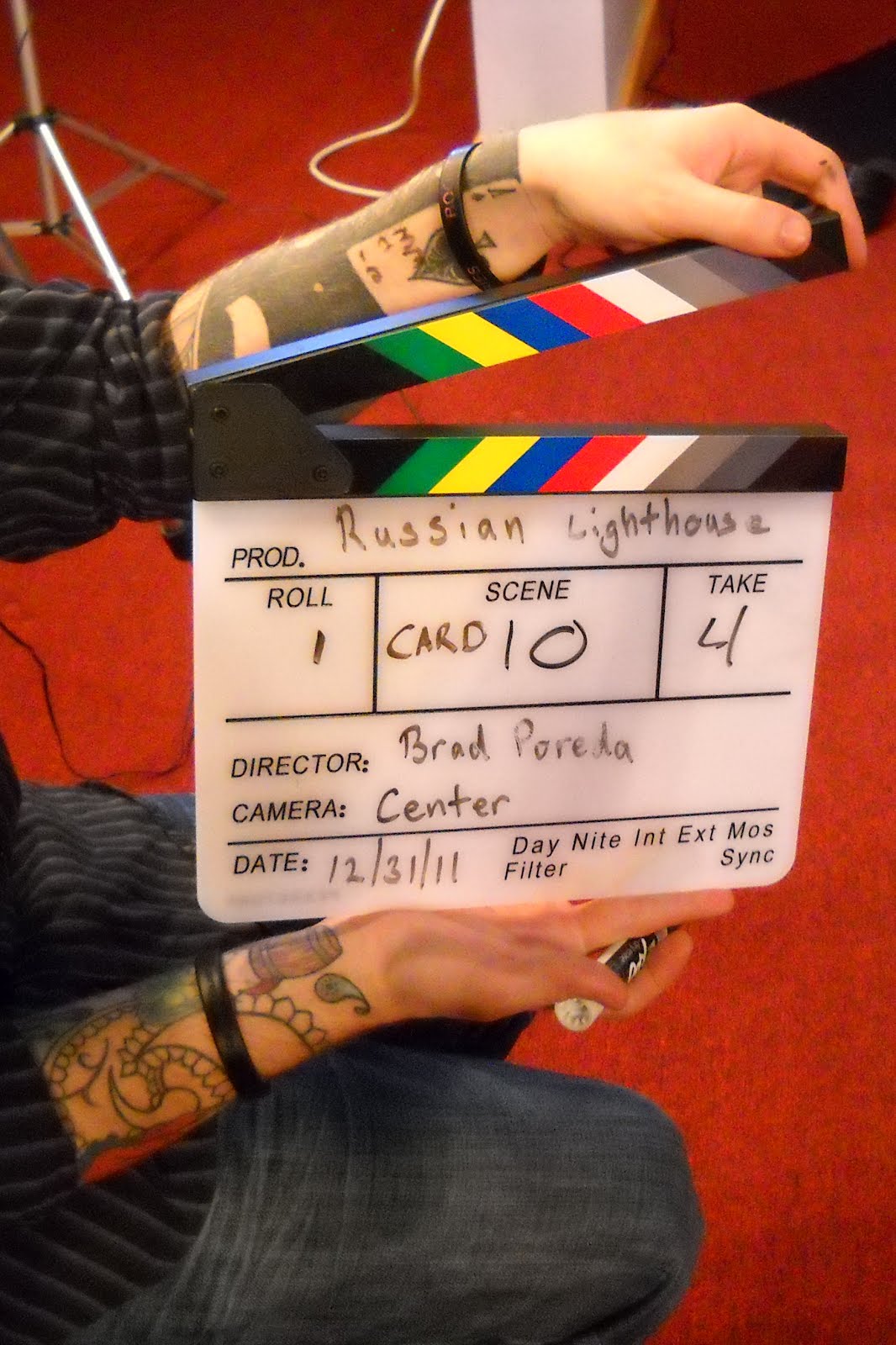
Six o’clock finds me in Jeff’s basement recording studio. A backdrop, large camera, lights, and several microphones alarm me, but the clapperboard labeled with my name makes things nauseatingly real. After several sound checks, practices of my introduction, and admonitions to slow down, Jeff says three of his friends will be helping Saturday. I should be delighted, but paradoxically, as this becomes more professional, I feel more stressed. As I leave, there is little solace at having survived the production meeting, as it is only prelude to what I truly dread. Jeff’s parting words, “Be here at 9:45 tomorrow morning,” ring like a threat.

Back at my in-laws’, I swallow nine Tums in a few hours; I haven’t taken nine the rest of my life. The next morning, I rise early since I’m not sleeping, and my nerves won’t tolerate a last minute rush anyway. I curl my hair, using a generous amount of hairspray from a travel bottle. I haven’t been anywhere since Russia last August, and I’ve forgotten how good it smells. A few minutes later, my hair looks oddly limp and lacks any hairsprayed crispiness, so I spray on more. When I smell the fragrance again, my confidence crumbles as I recall having refilled the bottle with body spray for Russia. Too late, I know why my hair is flat. There is no time to curl again. I can only put on my makeup, and go.

I am leaving when my mother-in-law asks an innocuous question; I start breathing hard and can’t answer. Next, I have a prickly head, and tears are welling in my eyes. “I can’t cry! I’m not going to cry!” I implore myself, as there is no time to clean mascara streaks if tears fall. I threaten to faint while she tries to shepherd me outside into Oklahoma’s omnipresent wind. I am coherent enough to resist, as I intend to salvage the little remaining wave in my hair. Finally, she pushes me into the car, and I calm down in the seat. “Just remember it’s not a matter of life or death,” she encourages me as I depart.

“It’s not, for me,” I agree, hoping she realizes this is life and death for the orphans I’ve met.

Jeff’s friends Brad and Doug arrive shortly after I do. Armed with microphones and cameras of their own, they eventually disassemble most of what we’d checked last night. As they decide where each gadget belongs, I strive to block out thoughts that this is all for me, and that I must deliver to make this worth their efforts. They rearrange the backdrop, overturn a couch, swap chairs, argue about placement of four cameras offering different angles, and call for props. As they work, they refer to me as “the talent.” I understand the lingo, and I am the authority here on my topic, but my inexperience makes the phrase feel hideously satirical.

Doug has a golden voice, and a new NPR show, Wind and Rhythm, to go along. He offers patient pointers on how to modulate my voice for best effect, but my weary, cortisol-addled mind renders me a slow study. I incorporate the hints I can, though most would take me years of practice to perform naturally. I have a large-print outline on a music stand just below the camera’s lens, acting as a primitive teleprompter. As I practice, Doug dislikes my reliance on the outline, so I end up taping short notecards to the stand, and they’re usually sufficient to jog my memory. He reminds me repeatedly that I’m only speaking to one person. I try to speak to the camera, but find it nearly impossible to project emotion to its black hole. Finally, he stands behind it at my eye level, and responds with exaggerated facial expressions to my words.

At 1 p.m., we’re ready to start filming. I am to be looking down when the camera rolls, then look up pensively before beginning. None of it comes naturally, except the mistakes; some elements need five or six takes before I get them right. It isn’t that I don’t know my material; in one sense, I have delivered this speech literally one thousand times, with the call notes to prove it. It’s just the medium is so foreign, and I’m so self-conscious, that the thought of having kids’ lives resting on my performance seems wickedly farcical. Tim, Jeff’s intern, sports enough piercings to look tribal, and an impressive array of tattoos darkens his arms, but he announces each take and scene with a fatherly patience and gentle clap of the clapperboard.

Rare parts of the presentation go almost well, and midway through, I accomplish a few segments where we don’t have to stop at all. But usually, even when I do a section multiple times, we have to settle for the best of several takes as “good enough.” Mercifully, just short of an hour, we’re done filming.

For the next several hours, Jeff and Brad download video from all four cameras. When Brad goes home to care for his dogs, Jeff and I start adding photographs. Timing them properly is maddening, and I wonder if any viewers will appreciate the photos enough to recompense our work. When Brad returns and we start editing, I learn the only thing worse than watching myself on video is watching myself make mistakes on video, while others focus on the miscues to decide which of the takes are least marred. But Jeff and Brad are unfailingly kind, and I never hear them laugh, except when I mess up my ending thank you by proclaiming, “Thank YOU for helping the Russians!”

Our progress is sloth-like, though. It’s New Year’s Eve, my favorite holiday, and I traditionally host a party. It grieves me to miss this; worse, I’m in the Central Time Zone, so I’ll have to delay my first Coca-Cola in a year for an additional hour (The Real Thing, 1/29/11). I’ve been in a 365-day countdown to toast my husband with a Coke-filled goblet at the stroke of midnight.

My mother-in-law knows I am disappointed, so she thoughtfully plans a little shindig for me. But as editing drags on, it’s clear I won’t even make that. I welcome 2012, not with the Times Square ball drop, but by watching the time change on my computer screen. Jeff has a refrigerator outside the studio stocked with Coke, but I can’t bring myself to imbibe without my husband. The moment I’ve ached for is here, and I’m in a basement control room. I almost start crying, but compose myself since Jeff and Brad are giving up their New Year’s Eve, too, and Lighthouse is not even their mission. I fret that by the time I leave, drunks will be out, and I’ll never get to see my family, drink my Coca-Cola, or help my orphans. About 1 a.m., Jeff’s wife delivers pizza, which cheers me as I hear myself intone about the orphan prostitutes of Russia for the umpteenth time.

For the end of the video, I’ve envisioned a quick photo progression of kids our work has helped, accompanied by the sound of cards shuffling. But for the thousands of sound effects on the software, cards aren’t one of them, so Jeff tries valiantly to create it himself. Brad hears the result and frowns. “You can’t use that! It sounds like farting!” he chides, suggesting a xylophone instead. Jeff searches online, and eventually finds an ascending chromatic scale. It’s perfect.

At 4 a.m., the parts needing my input are completed. Brad has fussy touches to finish, and thinks it will go faster if he is alone. I lay down on a couch in the recording studio, bemoaning the hour, yet solacing myself that the drunks will be home before I leave. I never really sleep; I just listen to my spiel ad infinitum as he works.

At 6:30 a.m., dear Brad is done. As he gives me a hug before leaving, I could almost cry that he gave up so much time to help our orphans, when he doesn’t know them, or me, or the Lighthouse Project. I thank him profusely; he’ll never know how much I’ve appreciated his help and expertise. While I didn’t give him much to work with, he has done a technically masterful job.

Jeff still has to copy the discs. When the first is done, he asks me to watch it. How many things I wish I would have worded differently, or could have written rather than spoken! I am not satisfied with my performance, but thankfully, it isn’t terrible with the most egregious errors edited out. After the second copy is made, I finally stumble to the car. The clock on the dash says 8:00 a.m.; we have worked on a 19-minute production for just over 22 hours straight.

I’m in a fog, but I drive slowly and meet only churchgoers on the road. Arriving at my in-laws’ house, my father-in-law comes out to greet me. I see him, and start to sob hysterically. I have been waiting all night to break down; the pressure of orphans needing me succeed at something so stressful is too much to resist longer.

Three hours later, smeared mascara washed from my face, I board the plane in Tulsa to return home. I can scarcely believe this video ever got made, especially under such crazy circumstances. Furthermore, the quality is far superior to anything I dared plan when Hope first asked me to do it. My heart might explode waiting for her return, so anxious am I to let her know not only did we work on the video as promised, we also finished it.
Arriving home Sunday night, I’m too spent to do anything besides collapse into bed. The next day, January 2, I cook my favorite dinner. With my family gathered round the table, I pop the top on my first Coke in a year and a day. I close my eyes and relish the fizzy assault on my nose. I could attack the Coke, but I delight instead in my deliberate control, knowing I am crossing my Rubicon. When I’m ready, I take one sip, and then another. It is thick, cloyingly sweet, and artificial. I don’t like it, not at all.

I pour a glass of cold water and drink deeply.

                         Somehow, I’ve survived.

See the video here.


Thursday, February 18, 2010

"Tell her you want a family, too!"

In the eleven trips I’ve coordinated, I’ve repeatedly observed quiet, compliant children are in grave danger of being overlooked, while obnoxious kids glide into families.   In all my trips, Denis is unique: his shyness landed him his family.  His hosts Aaron and Robyn heard about the Tulsa Russian Orphan Lighthouse Project through another hosting friend, and signed on shortly before the trip. Like 80% of hosts, they expected to serve only as a bridge between an orphan and an adoptive family, until Denis’s painful reserve stabbed Robyn in the heart. One morning, eyes brimming with tears, she confided she had a quiet child already who, dropped into a similar situation, would never shine and find a family on such a trip. That epiphany, time, and prayer proved the prompts her family needed to pursue adoption of Denis.

Joining Denis on that trip was his best friend, Dmitry. During Dmitry’s visit, he craved hugs, loved laughing, amazed his hosts Lee and Stacey with his artistic prowess, and declared his wish for a car and garage some day. Though initially afraid of the family dachshund, her name was the first he learned, and soon cries of “Louuu-see!” were followed with laughter as she sprang into his lap. Lee and Stacey raved about his attitude, organization, kindness, and enthusiasm for their activities. At the community program the Lighthouse kids present on our American trips, Lee hoped to give a testimonial on his behalf, and seemed genuinely disappointed when I declined. Dmitry, in no demand at age thirteen, returned to Russia with the prayers of his hosts, but without an adoptive family.

In December, after Aaron and Robyn appeared in a Russian court to finalize Denis’s adoption, they left him in the region, as required, and returned to Moscow. Denis, briefly back at the orphanage after spending time with his new family, called our Russian coordinator Love while waiting. Too retiring to ever have pled his own case, but acting with the urgency of one fearing to leave his best friend hopeless, Denis offered Dmitry the phone. As Love spoke with Dmitry, she heard Denis imploring in the background, "Go ahead! Tell her! Tell her you want a family, too!"

In our autumn visit, we saw desperation at Denis and Dmitry’s orphanage we witnessed nowhere else. Kids there made efforts, heartbreaking in their failure, to dress up for us; one boy, already too old for international adoption, sported a shiny polyester suit as he pled with his teacher, “Will you show me to them?” Departing without meeting everybody, kids followed us out the door, some even chasing our car as we drove off.

Waiting in this forlorn place his few last days before his family’s second coming, Denis, erstwhile orphan but now a son, disdained to save only himself. Summoning strength he’d not shown in his own search, now he’d do what he could to pass his blessings on.


Friday, December 25, 2009

One Small Child


While much of the Christian world is commemorating the birth of a baby adopted by His earthly father 2,000 years ago, the Orthodox Church celebrates Christmas January 7. For most Russians, today is like any other, but for a nine-year-old boy from a forsaken hamlet, this December 25 will be one to treasure always.

An orphan most of his life, two years ago, Yuri, then seven, looked out his orphanage window and recognized a family he had met on a Lighthouse Project trip to Wisconsin. Elated they had come for him, he bounded from the building, leaped into their armsand found they were there for another child. Devastated by his despondency, our entire program intensified efforts to find his family. Subsequently, he was scheduled for three different trips, though illness always precluded his travel. When an orphanage director’s fiat later prohibited Yuri, an insulin-dependent diabetic, from traveling again, advocating for him became more rigorous, since any family would now need to visit him in the motherland, rather than the States. After impassioned conversations with scores of families, one finally promised to adopt him, but abandoned the process after several months.

One year later, in desperation, I wrote about Yuri in this forum (Waiting Heart, Wrong Arms, 5/8/09). In June, Aaron and Robyn, adopting a child from my January 2009 Tulsa trip, read the post. In faith, recognizing him as their son, they visited him in Russia. On their first morning together, an awakening Yuri opened his eyes cautiously, fearing he had sabotaged a magnificent dream. But seeing Robyn’s smile, he beamed, chirped “Mama!” and stretched out his arms for a hug.

It was real. He had a family.

While Yuri had waited much longer, my role as matchmaker was two years coming, and wholly satisfying. A much-loved aunt, to whom my mom donated a kidney, is a lifelong diabetic, so I felt a deep connection though I had never met him. In October, when I visited his orphanage, Yuri was the child I most hoped to see; while I am not especially maudlin, I brushed away tears as Faith introduced me as a friend of his family-to-be. Gifted a shy smile by this boy we’d hoped to help forever, it was my most gratifying Lighthouse moment.

Celebrating the birth of another adoptee this day, our presents recall that first Christmas when the greatest gift was given. Early this morning, half a world away, another gift was lovingly bestowed and joyously accepted, mirroring God’s own compassion. While we were still sleeping, Aaron and Robyn became Yuri’s parents in a Russian courtroom. His wait over, his leap into the wrong arms history, his life in a family just beginning, a world of promise awaits this one small child.

Yuri, it’s real. You have a family. Merry Christmas!


Wednesday, November 18, 2009

Seatbelts


In Russia: Day 11

Wednesday dawns with more dread than anticipation, since today is good-bye. When we get to the kids’ area, they’re not awake, so our breakfast is overly peaceful. Driver Dima comes and the kids get up; we gather in the common room for a tearful farewell. Love, our Russian coordinator, revered by our adoptive families, makes an emotional speech about how we have encouraged the kids this week, and given them reason for hope. I concur silently; it’s what keeps me coming back. Love adds that she hopes we’ll come again. I’m thinking I’ll be back in January for our next Moscow Lighthouse Project trip, but she really hopes to see the families, when they return to claim their kids. Forever.

Hugging each child, all express gratefulness in charmingly accented English. The oldest boy, one whom I wondered much of the week if would agree to adoption, gives me hope with his teary eyes as Love shares. Yulya hugs me tightly, but pins a heart-shaped plastic brooch with the word “Love” on Amy’s coat. Clinging to Amy, Yulya flips a switch and lights on the brooch flash. Another girl, Larisa, hangs from Amy and insists the gift is also from her. It’s at once tacky, sweet, and pitiful.

Todd and Ellen hug their two kids; one is Denis, my favorite child from my March Grand Rapids trip, whom they’ve planned since then to adopt. They’ve come now to visit an eight-year-old girl, a possible sister for Denis. I swiftly realized the four were a family. As they leave, they turn to look again at the kids. I feel for them; letting your kids return to an orphanage is one of the hardest things in the world to do. I’ve done it before, and don’t envy them.

I exit the hostel with Jamie. She’s saying she’ll travel in January so her husband can meet Dmitry, one of my favorite kids this trip. Wives don’t usually drag husbands halfway round the world to meet orphans, so for Dmitry, who confided earlier, “I hope someone will take me,” I am blissfully encouraged.

Larry and Ahna leave conflicted, unsure of which child they’ll adopt. They’re already adopting a boy I loved from my January Tulsa trip, and they’re after a brother for him this trip. While I’m not sure who their new son will be, I know another older boy has a family, so I enjoy a generalized delight.

As we pile into Dima’s van, Love wishes us well, blowing kisses. She’s still waving as we drive away and round the corner. Once she’s out of sight, I’m already missing her. A few minutes in, Dima tells us it’s a new Russian holiday today, Family Day, just initiated a year or two ago. It seems fitting that as we leave on a day set apart for Russian families to visit loved ones, each of my host families silently mulls whether to add a child they’ve just visited to their family. Down Moscow’s wide avenues, I see place after place with significance for me. Some are special from this trip, while others are sacred from my trip to adopt my own kids. Moscow isn’t home, but I have as many happy memories here as anywhere outside the Great Lake State.

At the airport, we walk through another dusting of snow. Inside, an agent advises our flight to New York City is delayed. Seeing the others’ dismay, I’m ashamed that I’m tickled pink. I was to arrive in Grand Rapids at 9:30 tonight, and leave at 3:00 a.m. tomorrow for an 870-mile drive to Tulsa. I had cursed my inopportune planning repeatedly; now the delay solves what my organizational skills couldn’t. I ask the agent to reroute me to Tulsa, rather than landing me in Grand Rapids at noon. With flexibility stateside airline agents should emulate, she cheerfully gives me several options as she rearranges my flights. I’ll overnight in New York and fly tomorrow to Tulsa, where I’ll meet my long-suffering husband and four angels after their drive.

When we finally depart Moscow, I eat dinner, then fall into a deep slumber. I never sleep more than a few minutes on planes, but this flight comes at the end of an almost sleepless eleven days. The trip is over in no time, and I awaken to a flight attendant’s welcome to JFK. Clearing customs and immigration with bleary eyes, I am saddened by the imminence of my farewell to my host families. Bidding adieu, my heart swells for these friends who will help the orphans so close to my heart.

At the hotel, I play insomniac. I talk to Elaine two hours, as she debriefs me on the Lighthouse portion of my trip. She is hungry for details, since she left just as the families arrived. I hear my husband’s voice for the first time since I left; it’s better than e-mail. When I finally nod off, it’s with thoughts of a repeat in just over two months. I can’t contain myself; I’m excited already.

In morning’s wee hours, a taxi speeds me toward the airport. I should be thinking profound thoughts of some eloquent way to close my series on the Lighthouse Project’s first trip to Moscow, but I think only about how strangely glorious it feels, tearing through a strange city in a taxi, buckled in a working seatbelt.

Until next time, “Pah kah” from Russia.


Tuesday, October 6, 2009

Hopeless?


Misery loves company, or so they say, not that shared misery has helped Elena and Lidia lately. The girls, sisters, have a story like most of the orphans who seek families with the Lighthouse Project: biological parents who put the bottle before their kids, ultimately shrugging off their parental rights rather than sobering up.

Elena, 14, and Lidia, 12, have been devastatingly close to coming to America before. Scheduled to travel to Missouri in July, an anxious family I believed would adopt them readied for their arrival. Shortly before departure, a passport issue struck them from the trip, and their host, a teacher, had summers-only availability. Since I planned they’d travel instead on my August Tulsa trip, I didn’t worry. Then the swine flu travel moratorium kept the kids in Russia. Our new “Plan C” is less ambitious: the girls stay closer to home on our October Moscow rendition of the Lighthouse Project.

Lidia, the younger, is hopeful and smiley. She likes skating, and befriends smart, kind, good girls. Asked about America, she admits she’s not heard much. The sixth grader excels in school and enjoys music class, especially when composing is on the docket.

Elena, the elder, seems more affected by her past, less willing to trust the future holds promise. In her interview, she never cracks a full smile, though she tries when Lidia joins her. She praises her friends for their understanding and helpfulness; she disdains dishonest liars. Asked what rules she would make as president, she says she’d decree drinking and smoking illegal; this is a popular orphan response. She sounds ashamed confessing that after three years of orphanage life, she’s gotten used to it. A stellar student with high marks in English, she says she wants to be a lawyer, but quickly qualifies the aspiration, “I don’t know if it will happen.”

Elena turns 15 in mid-October. As long as her younger sister remains available, Elena is eligible to enter the United States on an orphan’s immigrant visa until her eighteenth birthday. But should something render Lidia not available, Elena’s fate is sealed at sixteen, since she cannot enter the United States alone at that age. And if she’s not adopted, Elena’s more likely future is on a corner than in the courtroom. I have no leads on a host for the girls; if the trip happened tomorrow, they’d be left behind. Again.

It troubles me that so many of our Lighthouse kids have Pollyanna-like idealism bearing no resemblance to the likely future that waits in Russia. But the true travesty is Elena, with potential in spades, has aged out of her idealism, with good reason.

I never thought the world needed another lawyer before. Now, I do. Elena’s other option is much grimmer, but without a family, more likely. I recoil envisioning this sad girl forced into prostitution, and lament how impotent I am to stop it.

Monday, September 28, 2009

Peppered With Love

Nicole called me first September 11, 2008; it’s in my notes but the date was easy to remember anyway. She was young enough that I wasn’t sure how serious she was, but she told me she’d always been interested in adoption. I could relate to that, though, and we had an encouraging conversation.

Within days, Nicole and husband Randy signed up to host a ten-year-old boy named Alexei. She was giddy as she outlined her plans for him for the week. It crushed them more than the other families when he was one of those kept behind in the orphanage due to last November’s quarantine. At the end, they hosted another child instead, but Alexei had already stolen their hearts. When he finally arrived in Tulsa for his trip in January, he was an obvious fit for their family. On the return flight to Russia, he flashed business cards with Randy and Nicole’s photos on them to the translator, insisting he wanted them to be his family.

Two weeks ago Alexei could put away his cards. Randy and Nicole arrived in Russia, went to his orphanage, and were welcomed like dignitaries. When he saw them, he bounded to them and leaped into Nicole’s arms, hitting his head hard on her lip. For the rest of the trip, she savored how happy her new son was to see them every time she noticed her sore mouth. Though they’d worked for this moment for months, Nicole was nonetheless taken aback by the intensity of her love for Alexei as he thanked them repeatedly for adopting him.

There were other kids at the orphanage and they swarmed the American visitors. One especially winsome boy proudly exclaimed all the kids had washed and put on their best clothes before they arrived. He asked them if they were Alexei’s mama and papa, but haunted Nicole when he added, “Do you like us?” I could envision the little chap and the look on his face as he queried; the boy was Denis (yellow circle on shirt), my favorite child from the March Grand Rapids trip. Several of the thronging orphans tried to curry favor with Randy and Nicole, making it clear they wanted to go along, “auditioning” for their own chance at a family. Kids never understand how much work has gone into the adoption before parents ever come through the orphanage door.


After court, they returned to Moscow, where Alexei purchased a gift for his new mom. They visited the traditional Moscow biggies, played football, and cuddled as Nicole counted his freckles, losing track at 122. Friday, Alexei arrived home in Tulsa, with a new, American name meaning, “saved by God.” Seldom are names so aptly chosen. Returning home to Grand Rapids late Thursday from my own vacation, I could not be in Tulsa in body, but was present in spirit.

So to Randy and Nicole: Congratulations! Your heart for orphans shines through as you’ve helped with the Lighthouse Project and now taken the ultimate step in orphan ministry. While your time in the orphanage was short, remember the kids who touched you in Russia. Even a minute with such neediness leaves you forever changed.

To Alexei: Welcome to your new family and country! We promise to keep working diligently to find families for the friends you left behind. You’ll be proud to see your parents are a part of that.

And to Denis: Yes, Alexei’s mama and papa did like you and your friends, more than you’ll know. They sent photos for me to pass on to your own mama and papa in Michigan. It won’t be long before your friends wash again, donning their best to meet the new parents coming to the orphanage, for you.

Wednesday, August 19, 2009

Missouri Loves Company


Last week, shrugging off advice we rent, we’d driven our one vehicle, an older, high mileage Silhouette threatening to strand us, to Tulsa. Excessively emboldened by our trouble-free trip, we left for Tulsa this time serene in the confidence of last week’s precedent.

I don’t expect I’ll drive to Tulsa again without stopping to see my sweet friend, Missouri Lighthouse coordinator Elaine. On Friday, we’d made good enough time through the night to justify a lengthy visit. Elaine and her husband Kenny own a car dealership in St. Robert. Per our request, they’d been watching for a van in our price range to replace the Silhouette. Elaine was working, so we visited her at the lot. Walking into the showroom, we laughed that the trade-in value of our wheels was surely rising with its reliability on our frequent Tulsa runs. After a three hour stop, we waved goodbye and hurried on our way.

I-44 in central Missouri is a scenic route wending through tree-crowned hills and limestone outcroppings. It was a scorcher, and as the van labored up a hill near Conway, 45 miles west of St. Robert, it became clear we’d taken it one trip too far. Providentially, we were near a downhill exit so the van coasted off the interstate. In my humiliation pushing it to a gas station, I had visions of Julie arriving at the airport, new brood in tow, oblivious to the extent we’d gone through to greet them there. Adding to the comedic inconvenience, our cell phone chose this particular day not to work, so we were left to plead for techno-mercy from passersby. People always love my children, but this time we benefitted less from their charm than their urchin impersonations made doubly convincing by riding all night, then being stranded in the hot sun. Lent a phone, I called Elaine, scarcely recounting our woes before she became a take-charge Wonder Woman without my even asking. Bidding me not to worry, she promised to call in their driver, send a flatbed truck with a minivan we could take on to Tulsa, and take the disabled van back to the dealership. She also called my mother-in-law in Tulsa, telling her to go to the airport herself, since we’d likely be too late to make it.

Sitting at a gas station table in resignation, we consoled ourselves knowing Julie would realize it was the thought that counted. We cut a piteous enough pose that a station employee offered us a pizza she’d made in error. When the flatbed arrived, our things were ready and we leaped into the replacement van. With a little more than three hours and 220 miles to go to Tulsa, it seemed remotely possible that with smooth sailing, we might make it in time to the airport if we hurried.

Entering Oklahoma, we’d made great headway, so I made my welcome sign en route. Close to the airport, we found that, not only would we be punctual, but we would be early. When Julie, Dave, their two biological sons, and three new children entered the waiting area, our family was there waiting, looking like we’d spent the day by a busy road, but waiting nonetheless. How delightful to surprise my serially hosting friends, to finally meet Vladimir, and to hug, then hug again! I wanted Julie to know how special her adoption was to us, and I think she understood.

Elaine called later while we were at dinner and said we could take the van back to Michigan while we looked for something else. But after our 220-mile test drive and the impeccable service of Mid-Missouri Motors, we were interested in the van Elaine and Kenny had graciously lent us. Our van shopping had been conveniently completed alongside the Missouri interstate-- no going to look, no wondering about color, just grab it and go, no fuss at all.

On our way back home today, we went through a toll booth in Oklahoma. The same collector from last week saw our kids in the back and told Randy, “Be careful driving. I see you’ve got precious cargo there!” Even the toll people are friendly in Oklahoma; it’s one of the reasons, besides being Julie’s home, that I love coordinating Lighthouse trips there. Through Rolla, we stopped again to see Elaine, Kenny, and their kids at home; we showed off our new van, but they acted like they’d seen it before. Seeing them on weekends could be habit-forming.

Blessed emotionally last week’s trip, we were blessed physically this trip with providential care at every turn. We broke down close enough to Elaine at a time she could help us, we got an especially long test drive of a vehicle we needed anyway, and we avoided a trip to Missouri later to look at other vehicles, all in time to see dear friends come home. As if that weren’t enough, the deal was sweetened with free pizza.

Sometimes I wonder why people are so nice to us. The answer is God directs us every step of our way, putting us where we need to be, when we need to be there, and allowing us to meet those we need to meet. As we have blessed, we have been smothered in blessings. God has been good to us again and again. And now He wants to use us to bless others.

Tulsa, Times Two


Having spoken to hundreds of potential host families in thousands of conversations, I’ve developed a sixth sense as to what flies and what doesn’t. I’ve learned cold calls are an exercise in futility. No matter how highly recommended a family comes, if they lack the motivation to make a call, they’re unlikely to care enough to host a child. I never break this rule, but did once, for which I’m thankful.

Days before the arrival of November’s Tulsa trip, I needed hosts and felt desperate. I heard about a family looking to adopt who might be interested in hosting, so with gritted teeth I acquiesced to a suggestion I call. When Julie picked up the phone, I apologetically introduced myself and braced to receive a bum’s rush that never came. Instead, with a smile in her voice, Julie proclaimed her gladness I’d phoned. Two hours of talking and laughing later, I had another host family. I didn’t know it yet, but I’d met a serial hoster.

Julie and her husband Dave hosted ten-year-old Dima; eight-year-old brother Vladimir was unable to travel. Midway through the trip, Julie tearfully confided her dread of Dima’s return to Russia. She loved him she said, but more important was how she said it: “I’m trying to memorize every freckle on his face!” The attention to minute detail in her love sold me, once and for all: Julie was a keeper.

January brought another Tulsa trip. Asking her to host would have been heartless, so busy was she with her own adoption by then. But nearing arrival and in another bind, I asked her anyway and was elated by her joyous agreement. Julie was a godsend: a snap of the fingers sent her scurrying to assist. She met me at the airport when I arrived in town, lent me her phone for the trip’s duration, and brought bags of food my second day when I admitted mid-afternoon that I’d been so busy with calls I hadn’t shopped, having eaten only a package of cinnamon Tic Tacs in Tulsa. When she knew of a need, Julie was quick with a hand and sympathetic ear.

I faced my March Grand Rapids trip with despondency, by now believing Lighthouse incomplete without Julie’s involvement. Besides being a dear friend, she endeared herself further as an aficionado of my blog. She called breathless one day about fifteen-year-old Ekaterina, whom I’d recently written about. (Marching On, 2/2/09) I was shocked, but after praying about it, Dave and Julie decided to host her in Michigan, earning the honorific of first family found by blog. I was there when Ekaterina called her “Mom.” Julie sniffled, “I’ve never been called Mom by a female voice before!” Because they were already in the process of adopting Dima and Vladimir, the couple was able to add Ekaterina to their adoption without much paperwork fanfare, important since she was on the cusp of her sixteenth year. (Choking Up, 4/3/09)

I’d intended all along to welcome them at the airport when they returned with their kids. But timing was inopportune, since Randy and I had driven to Tulsa the previous weekend to attend a welcome party for another adoptee. Additionally, I was due in Tulsa days later for the August Lighthouse Project trip. We reluctantly concluded I’d skip the airport homecoming, visiting instead during the August trip.

All day Thursday, it chafed knowing Julie was returning and I wouldn’t be there. When the Lighthouse Project director called me mid-afternoon to confirm the August trip had been cancelled due to the Russian swine flu resolution, I realized we could make Tulsa. By 5 p.m. we’d decided to go, though I wanted to be at the Grand Rapids airport that night to see fourteen-year-old Masha arrive. Her parents had worked valiantly for seventeen months to fundraise for her adoption; I’ve seen families with much more miniscule obstacles abandon adoption plans. All the while, Masha’s parents were team players, attending others’ airport homecomings and almost all the Russian adoption functions I was at while they awaited her. I owed them a welcome of their own upon their return.

After Masha’s homecoming we finished packing, setting out at 1:20 a.m. Friday. Julie would be in at 7:50 p.m., and with an 870-mile drive looming, we couldn’t procrastinate. Knowing my mom wouldn’t sleep because she’d be praying us to Tulsa, I felt guilty. At that same hour we left, Dave and Julie were in Moscow rushing toward the airport for their flight home, and dear Lori, who’d fundraised for her Inna’s adoption with a single-minded devotion, was beginning her session in the Russian court. So much was happening; I clearly had my own prayers to say on behalf of friends half a world away. With Randy driving all night beside me the second weekend in a row, my kids cooperating in seats behind me, my mom’s prayers covering us, and friends in Russia finishing adoptions, commitment to the Lighthouse Project and the kids we help hardly distinguishes me.

Wednesday, August 12, 2009

Blessed, Part Two


In the crowd were other friends I joyed to see: a family who’d kindly sacrificed their chance to host last November when a quarantine spared their host child but not another’s; a family who hosted in both November and January, and heard yesterday it’s their turn next to get eleven-year-old Alexei; and a family who realized after reading my blog that God was calling them to adopt nine-year-old Yuri in addition to Denis, 13 (Waiting Heart, Wrong Arms, 5/8/09). It was a great pleasure to finally meet Mikhail and Alli, home July 10. Their sister, Tatyana, was the only child in their sibling group allowed by their orphanage director to come on the November trip, so I’d not previously met the two of them. When Tatyana recognized me, giving me a spontaneous smile and hug, Mikhail followed with a charmingly syllabicated “Hel-lo!” What a delight to see them all together, at home with their family. (Multi-Media, 11/15/08)

Earlier in the day, I’d been fretting about Lori, scrimping for almost 18 months to bring home fourteen-year-old Inna. (Struggling, 2/2/09) Tuesday this week, the call Lori’s faithful heart believed would one day come, did: her court date had been assigned, and she was to leave for Russia Sunday. Only one trouble: this fantastic news left her just six days to find the remaining $4000 for her adoption. Standing at the airport, jostled by euphoric sign wavers, a tear-jerking interruption in the form of a call from friends saying they wanted to help her left me absolutely choked-up and, uncharacteristically, not able to speak.

When I’d arrived at Katya’s party last evening, her mom thanked me for the fifteen-foot “Добро Пожаловать!” banner I’d sent to their home for their arrival, and invited me to come by and see it in her yard. This morning before departing for home, we stopped by, visited over raspberry smoothies, and heard enough anecdotes to choke up the most stone-hearted. After fifteen years in an orphanage, when my friend picked her up in Russia, Katya exclaimed in wonder, “I’m not an orphan girl anymore!” A few days after Katya’s court, she helped another teen-aged girl, Masha, prepare for her own court appearance. Katya, hunched slightly with cerebral palsy, advised shy Masha to stand up straight, pick up her chin, and speak to the judge with conviction. Katya suggested Masha wave her arms when saying she wanted to be adopted, her dramatic demonstration giving her advice a final air of credibility. On the phone, Masha’s new mom told me both Katya and my friend were “angels,” a description as apt as any. When their stay in Russia was over my friend flew home with Jesus’ saying, “I will not leave you as orphans,” resounding in her mind all the way. A call to my friend never ends before she prays for me, and she didn’t deviate during my home visit either, praying before we departed for home for straightened paths for my upcoming Tulsa Lighthouse trip.

I’m not home yet as I write these words, but it’s already abundantly clear the 1800 miles we’ll travel have come with blessing, plus interest, for the effort. It’s no surprise, I guess, since Jesus Himself said, “It is more blessed to give than to receive.” I gave a little, then received at every turn on this diminutive journey: devoted company for the drive; a visit with kindred spirits in orphan care; a chance to surprise my angel friend who never cries “Uncle!” if the question’s about giving; the immense satisfaction of an epic airport home coming I had a little role in; a gift of love to help extraordinarily patient Inna get her mom; and a story about an erstwhile orphan, not yet home, already helping another child seize her chance at a family. I know when St. Francis of Assisi said, “It is in giving that we receive,” he wasn’t talking about my little excursion. But whizzing by exits and mile markers as the odometer on the van creeps upward, my full heart knows he might just as well have been.

Sunday, August 9, 2009

Blessed, Part One


I took a road trip with my better half Thursday. Randy doesn’t just tolerate my Lighthouse Project activities, he embraces them. He never says no when saying yes will benefit the program in some way. Randy has cared for our four kids himself for stretches while I was out of town coordinating trips, spent his inopportunely-timed birthday at Chuck E. Cheese because the Lighthouse kids were having a get-together there, told me one hundred times to go ahead and pick up the phone for Lighthouse calls arriving at dinnertime, helped prepare mailings at all hours of the night, and gone on thankless paper chases for every trip I’ve done in the past two years. We left Michigan on Thursday, drove 870 miles to Tulsa, arrived at 5 p.m., and headed back Friday morning to Grand Rapids another 870 miles. While the story revolves around the few hours spent in Tulsa, for Randy it’s less compartmentalized. His cooperation borders on the fanatical no matter how creative my suggestion; a girl couldn’t ask for a more supportive husband. When I proposed this audaciously abbreviated trip to attend a welcome home party for a dear friend of the Lighthouse Project, Randy didn’t bat an eye, insisted of course we should do it, and said he’d drive. As it transpires now, we are speeding by semis less full than my heart has been in the short time since we left home.

Heading west on I-44 to Tulsa, I had a great excuse to stop and see Elaine, coordinator of last month’s stupendously successful Rolla, Missouri, trip. It was great to see her again; even three weeks apart left us with plenty of catching up to do. Randy, who’d been polite enough to show interest in my spate of stories about the Missouri trip, felt like he knew Elaine already when he finally met her yesterday. We ate lunch with her and her husband, celebrating their anniversary with more Lighthouse Project talk. Randy got a kick out of meeting another husband as tolerant of his wife’s Lighthouse work as he is.

Late afternoon brought Tulsa; my friend, for whose daughter Katya the party was held, had no idea I was coming. I’d been racking my brain for months trying to figure out what I could do to show her how special she and her family are to us. (Happy Birthday, Katya!, 7/9/09) So when I heard about a welcome party for Katya that would be like a baby shower, only for a fifteen-year-old, I knew I had to be there. When my friend saw me, it took three proclamations I’d come to Tulsa just to go to her party before she finally believed me. Each avowal on my part was punctuated by a hug from her. The third hug, when she finally believed I really was there just for her, was so emphatic that I had to brace myself to keep from falling to the floor. Her reaction was more than I could have hoped for. I didn’t know anyone else at the party, so I made literal small talk with Katya, given my painfully limited Russian vocabulary. When my friend’s phone began to ring, Katya called, “Mama, Mama!” and hurried the phone to her. She had waited fifteen years to call someone that; knowing I’d had any part in making that one word reality was worthy of a tear. Later, opening gifts, Katya found the partygoers’ generosity overwhelming, so her mom took over the unwrapping honors. Kids in orphanages are not accustomed to receiving presents.

After the party, there was just time enough to get to the airport to welcome a family arriving with new brothers Losha, 12, and Jacob, 15, both from the November 2008 Tulsa trip. (Tulsa World article, 11/10/08) I’m a veteran of countless airport homecomings, and the assembled throng was, by far, the largest I’d seen. The boys beamed from ear to ear when they saw the signs and heard the ascendant cheer as they entered the airport’s waiting area. Several of the family’s other children had stayed behind in Tulsa while their parents went to Russia. Reunited, their mom Marie cried and had to reassure the younger ones her tears were of the happy variety. That my own young daughter had the same reaction on my return from Russia years ago was worth a few more tears on my part. As Marie saw me in the crowd, her face registered shock. We shared a long embrace, and her whispered “Thank you!” gladdened my heart at having had part in the festal occasion. When they’d gotten Jacob at his orphanage the previous week, he was the only child there: the rest were at camps or with foster families for the summer. My dear friend Julie, also in Russia picking up her three new children, was along for the ride, too, and found it odd to see an orphanage sans children. I sometimes lament our efforts make scarcely a dent in the worldwide orphan population, but that vision of Julie’s was a sneak preview of what we work toward every day with our program.
***
Due to length, the remainder of this entry will be posted Wednesday.

Monday, July 27, 2009

Widows and Orphans

Having coordinated ten Lighthouse Project trips, I’ve heard every excuse in the book for not hosting. Some reasons are legitimate, some less so. A caller once claimed she couldn’t host because the trip was coming up too soon. Next time she had a few months’ notice, but she couldn’t plan that far ahead. I tire of the charade; sometimes I wish people would just say they’re not interested.

Copious notes taken during the course of myriad phone conversations show I can expect to speak with ten callers to come up with one host family. While I try not to judge callers’ decisions, it appears many people choose not to host when they reasonably could. Others can reasonably host, and do. But my favorite callers have good reasons not to host, and choose to anyway. They understand they can make a difference in the life of a child, and whatever legitimate excuse they might have voiced is silenced by this more substantial realization.

Justine called me for the first time one morning when I was in Missouri with the Lighthouse Project. Running late for Vacation Bible School, I begged out, asking if I could call her later in the day when I had time to do the conversation justice. She agreed, but I fretted all day that her first impression of my availability might discourage her from hosting. Back in my hotel room that evening, we spoke. As she shared her story, I was relieved to find it would take more than a conversation deferred to discourage her.

Justine had always wanted to adopt. She and her husband discussed it, opting to pursue it after they’d had biological children. Son Alden arrived. Two and a half years later she was eight months along in a pregnancy when her husband fell ill; one day later, he died of complications related to diabetes. Justine was left to deliver daughter Lilly alone.

She grieved, but found the hardest part was the demise of her dream of a large family. Over time, she began researching adoption online. Hong Kong stood out based on cost and openness to single mothers, but almost all available children had moderate to severe special needs. Justine decided to wait, believing Hong Kong was not in her future. She bought a house, her parents bought next door, and she began home schooling. Life was good again; she was content and hoping for no changes.

But two years ago, she began a word study of every use of “widow” in the Bible. As the months passed, she handwrote most Biblical references to the subject. God’s concern for widows clarified, she discovered that in almost every passage, orphans, too, received specific mention as recipients of God’s special compassion. Within a year, God rekindled her desire to adopt; Hong Kong was her clear directive. As she shared her plan with her children, family, and friends, she found unanimous support.

Beginning her home study, she hoped to adopt a child between the ages of Alden, now 9, and Lilly, now 6. Her agency balked at her plan to adopt out of birth order, preferring that she make her new child the youngest. Justine was open to physical needs like blindness or cerebral palsy; Down syndrome was on the list of special needs she did not expect to consider. But scanning a list of Hong Kong’s waiting children, an eight-year-old boy with Down syndrome tugged at her heart. Already traveling a circuitous path, both Justine and her agency altered course. The agency allowed her to sandwich a child between her two biological children, and Justine realized the little boy she’d seen with Down syndrome was her son. Wondering why such a precious soul waited alone over eight years, she concluded he was “just reserved for our family.”

In November 2008, Justine heard about the Lighthouse Project trip through a friend’s blog. She hoped to host next time in Tulsa, but we were already in town for the January 2009 trip before she was aware of it. When she got word that we’d be returning to Tulsa a third time, her initial reaction was dismay since she obviously couldn’t host in the middle of her adoption. She might need for her own adoption the $1000 it cost to host a child. Worse, if she hosted, she’d fall in love, want to adopt, and be unable due to Hong Kong law prohibiting concurrent adoptions through other sources. God reminded her she had $1076 in a memorial fund in her husband’s name, and brought conviction that her reason not to host was flimsy. Would she let a child stay in a dismal orphanage with a hopeless future because she might be hurt if she opened her heart? She had the money, and she had the time. The only issue was fear of emotional injury. All the while, God was asking, “How selfish can you be?”

Not very, as it turns out. Justine did call as I flew out the Missouri door toward VBS, and she was still polite when I finally called her back over twelve hours later. When she told me about her special needs adoption, needing to fund her own process, single parenthood, and busyness home schooling, I knew her excuse for not hosting would be more watertight than most. Remarkably, after listening to all the obstacles and mentally rehearsing my speech for when she would end, “God bless you, but I can’t host,” those words never came. Instead, she matter-of-factly told me her husband’s memorial fund had waited for just such a time, she planned to host, and to send her the details. Justine had enough potential excuses to fuel several of my callers who decline to open their homes; she didn’t use even one, choosing to give a little of herself to give a second child a chance at a future. “I’m just going to follow God’s leading,” she declared.

As I struggle to find hosts for kids for whom precious little hope exists outside traveling on such a trip, Justine sends out e-mails to her friends, asking them to consider hosting a child alongside her. She lamented tonight that she hadn’t yet found anyone. Meanwhile, her “yes” is far more moral support for this discouraged coordinator than all the “God bless you”s with which I’ve ever been rejected while promoting the Lighthouse Project.

Oh, that enough families would follow God’s leading so that none of our sixteen Lighthouse Project kids have to stay behind in Russia, staring down hopelessness! God can bless, and I trust He will, but it happens through people who, like Justine, put others before themselves to be part of that blessing.

Friday, July 10, 2009

Happy Birthday, Katya!

Working through interviews of kids for my July 2008 Lighthouse Project trip, I waded through an overexposed interview of a then- thirteen-year-old Katya. Amongst other things, she mentioned she was doing leg exercises, and I didn’t think much about it at the time. Understanding arrived past midnight on a July 2008 night at the airport as I met the kids in Michigan. Katya lagged behind, struggling to walk. She apologized to the translator for slowing the group and not walking better, and explained the stilted gait as cerebral palsy.

Katya was an immensely sweet girl, but the day before the kids returned to Russia I still had no leads. At VBS that last morning, a nice lady came to meet Katya; it was her fourteenth birthday. They shared the day and ate birthday cake together. By mid-afternoon, the family was “100% committed” to adopting her. Based on this assurance, I promoted only other children with a confident serenity that Katya had already found her family.

Happy Birthday, Katya, right?

Wrong. The next day the kids returned to Russia, though they had scarcely arrived home when the family changed their minds. They gave a few reasons, excuses, really, and nothing they hadn’t known at the time they were 100% committed. Not that it mattered: Katya was gone, I now knew she had special needs, and no other family had expressed interest.

Katya’s second chance would have been Tulsa in November 2008. When a last-minute, dysentery-inspired orphanage quarantine kept her, and six others, at home in Russia, it was Katya my heart ached most for. But the Lighthouse Project returned to Tulsa in January this year to give those quarantined souls, and a few newcomers, their chances at families. Katya came on that trip, played the piano, sang a solo at the evening program, and slept in what she proudly told the translator was a “princess bed.” Mid-week, her host mom whispered to me they loved her and how well she fit in their family. A decision to adopt was followed by a flurry of paperwork finished at breakneck speed.

Earlier today, less than six months after Katya’s departure, her parents-to-be stood in a Russian courtroom. The judge asked Katya why she wanted to go with people who’d traveled halfway around the world for her. The answer was as simple as it was profound: she wanted a family. There was no reason not to; the judge approved the adoption. Providentially, it was Katya’s fifteenth birthday. While she got what most kids her age already have, it was the well-chosen gift she wanted most: a family.

So to a very special family, congratulations! I pray for you the best adoption ever. May you be as blessed as you have blessed.

To Katya, I wish you the happiest of birthdays! Bring joy to the family that has brought such joy to you. You’ve found your family. You’re a daughter.

What a difference a year makes.

Monday, March 30, 2009

Smile, Nikolai!

Some Lighthouse kids are self-promoters, finding their families by force of personality. Some are clingy, finding their families when the parents realize they’re needed. Other kids come compliant, good, and quiet; were they not in your photos, you’d forget they were there. Nikolai, newly fourteen, reserved and unassuming, is such a boy. In Tulsa in January, other boys his age were boisterous, more bother, and adopted; Nikolai’s cooperation was less requited. Now in Grand Rapids, agreeable again, his future is jeopardized by factors outside his control: age, gender, and personality. He needs and wants a family, oblivious that on a Lighthouse trip, it’s possible to be so good and so little trouble that you’re overlooked.

Nikolai dreamed of visiting America, though rumors circulate incessantly around his orphanage that Americans adopt Russian children to harvest their body parts. Asked about his best friend, Nikolai described a boy he appreciated for his reliability and trustworthiness. But as of December, Nikolai’s friend was gone to Michigan, the first child adopted from their orphanage, ever. Without parents, friends in the orphanage become family, and Nikolai’s mournful eyes stared out the window as his best friend left with his new mom and dad, lacking any expectation they’d meet again. Traveling with Lighthouse in January, Nikolai arrived in Tulsa and phoned his friend daily, finding him not an organ donor, but a loved and cherished son. Ultimately Tulsa offered no family for Nikolai, but he enjoyed his first trip enough to return to America when opportunity knocked again two months later.

Quietly compliant here also, on day two of the trip I might panic prematurely that all is lost. But I’m not, yet anyway, because Nikolai has a reliable and trustworthy mentor, his best friend Sergei, providentially living with his new family immediately across the street from Nikolai’s Grand Rapids host family. When Nikolai arrived late Friday night, Sergei and his dad went to the host family’s home and stayed over an hour. Relishing his role as a voice of experience, Sergei showed Nikolai around, explained rules, and offered pointers that he, as my favorite Lighthouse child ever, was uniquely qualified to give. (It's a Boy!, 12/9/08) and (Welcome Home! Welcome Home!, 12/21/08)

Back at home after showing his best friend the ropes, Sergei’s parents went through their bedtime rituals with him. As a fifteen-year-old American boy, Sergei could feel too old to be tucked in by his mom and dad. But as a child only a few months removed from the loveless existence of orphanage life, Sergei harbors no such pretensions, soaking up this birthright of childhood. As his parents said their good nights, Sergei shared how he’d advised Nikolai to smile a lot, let his personality shine through, and show he was having fun so someone would want him to join their family. His mom encouragingly enthused, “You’re such a good friend!”

“He’s a good friend, too,” Sergei said. “That’s why I want to help him have a family.”

Thursday, March 5, 2009

Cheering

Attempts to recruit host families in recession-weathered Michigan had been taxing of late; it seemed almost everyone I spoke with had lost a job since our last conversation. I’d been feeling like a lone cheerleader in a dark, vacant stadium, goading enthusiasm from a nonexistent crowd, when the lights finally went on late Friday night. A dearly treasured friend of the Lighthouse Project left joyous news in a word-thrifty thirty-second voice mail, conferring hope beyond my deserts and allowing a euphoric Oklahoma family to say yes to Lima’s adoption.

Five years ago another friend adopted Lisa from Russia, only to discover impossibly late that she had a younger sister named Lima in a different orphanage. Home in Michigan, Lisa settled in but didn’t forget her sister left behind, faithfully praying and tirelessly spreading the word of a waiting orphan in need of a family. Sweet Lisa’s prayers got an emphatic affirmative at 9:03 p.m. last Friday in a message that stole my breath away. That news of this joy could be imparted with such economy in verbiage was art I did not equal in ensuing conversations with the new family, Lisa’s mom, and the Lighthouse Project director.


Since Lima’s family-to-be didn’t even know about her while the January Tulsa trip was in their town, they’ll host her in March in Grand Rapids, Lord willing. Besides meeting her new parents, Lima will see Lisa in a poignant reunion I’d give anything to witness. I expect they’ll embrace, maybe hold hands, as Lima shares with Lisa what her last five years have held. While Lisa no longer speaks Russian, she recalls orphanage life sufficiently that her heart will understand what this week means to Lima. In a mercy gifted by youth, Lima will not struggle wondering what words of gratitude would be appropriate for the sister whose prayers have secured her place in the heart of a family.


At my age, I suffer no equivalent delusion. I ache to convey appreciation to my Friday caller, but can't assuage apprehension that anything I’d say would be woefully disproportionate to the gift. I must trust the determined love that compels Lima’s new family to venture across the country, then around the world, speaks the volumes of thankfulness I only wish my words could.


As I continue seeking families for March, I have new optimism that I’m no longer alone in my Lighthouse stadium. The stands aren’t packed yet, but benevolent friends are filling them. With prayer and more effort we’ll be ready by game time. For a new family beside themselves with elation, for Lisa who prayed without ceasing, for our incredible friends who will never know the depths of the Lighthouse Project’s gratitude, and for Lima who waited five years and two visits to find the family who will love her, I am cheering tonight.

Monday, February 2, 2009

Marching On


Questions about which kids found families are hallmarks of the end of a Lighthouse Project trip. While patience is a virtue I still need to cultivate, I’ve found trips like these might take a few months to completely sort themselves out. That said, some families were definitive enough that I am quite confident these children have found their forever families in Tulsa: Alexei, Denis, Ekaterina, Vladislav, Larisa, Eduard, and Sergei. Anton M. and Ivan have families seriously considering them, fomenting realistic hope within that I might move their names one sentence forward, soon. Three other children have families giving them some level of consideration, and two returned to Russia without any prospects of a family.

The January kids were still en route to Russia when I began anticipating my next trip, yet I confess more shock than elation at being asked last week to do a March program in Grand Rapids so close on the heels of Tulsa. Since I live there I could not argue that Grand Rapids was inconvenient, but the drain of my incessant efforts to stoke interest in January kids who might die if I failed has not, even now, subsided. Leaving on a Lighthouse sabbatical tempted, a larger tease than I would have expected. It would not have been for long; even in my three short visits to Russian orphanages I sensed an emotional permafrost that mocks the Siberian tundra. Nonetheless, it took a final appeal to the immediacy of that need by my friend Hope, the Lighthouse Project director, to extract a yes to coordinating a trip sooner than I would have chosen.

My favorite child from Tulsa was a freckled, blonde-haired nine-year-old who enchanted me, proclaiming his love of homework and English classes, and topping it off with a Russian-accented English rendition of “We Wish You a Merry Christmas.” While I work until the wee hours of the morning on behalf of every child entrusted to me, I especially liked Vladimir. Occasionally there are kids so winning I cannot understand why no one picks them; I have settled on the explanation that it is God’s will and timing, and that their family must either be somewhere else or they don’t yet know there is a Russian child searching for them. For one of these reasons, Vladimir did not meet his family in Tulsa. A few years ago, the Russian government started compensating families for providing foster care to orphans. Foster care has become more popular in poorer regions than the rest of Russia as government payouts for care have increased. While I would not paint all Russian foster families with a broad brush, does it take a cynic to wonder if there’s a connection, and why only families in poor regions want to foster? And is it a coincidence that once kids reach the age of sixteen, when government payouts cease, many foster families suddenly lose interest in the kids and turn them out to the streets? The Lighthouse kids’ region is quite impoverished and Vladimir’s orphanage, my own kids’ orphanage “alma mater,” is a hotbed for foster care. A child of his age would most certainly be picked by a foster family before I could do the next available trip in June. By consenting to do a March trip, perhaps I can save the boy who stole my heart with his song from a lifetime without a family who loves him.

Also scheduled to travel is fifteen-year-old Katya. Only nine months from her sixteenth birthday, Katya will be unable to enter the United States on an orphan’s immigrant visa once she reaches that milestone. At the stroke of sixteen, hope of adoption is fruitless, leaving little to anticipate beyond an unspeakable future of degradation and a brutishly shortened life expectancy. A trip delayed until June would be three months closer to a sixteenth birthday promising to be anything but sweet. Maybe by taking action just a few months earlier we can rob the Russian streets of a charming girl who still has the audacity to dream of life as a chef rather than life as a prostitute.

The clock doesn’t stop for Vladimir or Katya. I must be as relentless.

Friday, January 16, 2009

Lima


Lima (LEE-muh) has a biological sister, Lisa, who was adopted several years ago by one of my dearest friends in adoption. Lisa now lives in Michigan with her family. Desperate for Lima to find a family of her own, she has been asking everyone her family meets if they would please adopt Lima. It’s challenging to find an adoptive family in Michigan for an eleven-year-old Russian girl visiting Tulsa for a few days, but Lisa is persevering anyway.

The first morning Lima was in Tulsa her host mom asked what she’d like to eat. In a charade with Lima “holding” a cone and pretending to lick it, her host mom deduced she’d like chocolate ice cream for breakfast, so the entire family shared a chilly meal. At Wal-Mart shopping for clothes, Lima chose a dress she thought a princess would wear and unseasonal high-heeled sandals. Her host mom, whom Lima called the Russian word for “Doll” when she forgot her name, melted at the joy with which the sandals were shown and could hardly say "nyet." At home, Lima enjoyed bubble baths, ate second and thirds of everything, and was transformed into Princess Lima with a flower girl dress and tiara. In an interview, the translator said Lima likes math. When Doll asked Lima if this was really true she was surprised to hear, “I like math, but I like bunnies better!”

Several days into the visit, Lisa called Lima and the two sisters heard each others’ voices for the first time in five years. Lisa had forgotten most of her Russian, and Lima’s English was limited, but Lima knew who Lisa was. She spent the rest of the day smiling and saying “I love you!” in honor of this conversation. Lisa sent a gift she’d made small enough to fit in the one carry-on Lima will be allowed to return to Russia with. Lima was expecting this package and made a point of asking every Russian speaker to ask Doll when her “big surprise” was coming. Much to Doll’s relief the surprise arrived in the mail this afternoon in time for Sunday’s morning return, containing two tiny dolls, a handkerchief embroidered by Lisa, a drawing, a letter, and a photo sheet. When Doll’s mother arrived, Lima ran to her yelling, “Babushka! Babushka!” pointing to both her own eyes and Lisa’s eyes in the photos. Lisa is a beautiful girl and the similarities were unmistakable.

Yesterday Lima went to the dentist. Through a translator Lima explained that she fell when she was little and hurt her jaw; consequently, her teeth are growing in very crooked. When she confided in the translator the reason she believed she was ugly and deformed, Doll begged to differ. The dentist said her smile could be corrected easily enough with braces. About 50% of children in America need braces, so Lima is no different than most, except she doesn’t have a mom or dad to provide her dental care or reassurance that she is beautiful when she doubts it.

Most crucially, Lima has a heart that is kind and good. She loves to help and aspires to be a doctor. While this is an unlikely occupation for the child the orphanage staff calls the “sunshine girl”, Doll thinks she’ll be a huge blessing for a family, adding, “She has been to ours.”

Thursday, January 15, 2009

Mud Slinging


The January Lighthouse Project suffered a lamentable lack of big-time media coverage in Tulsa in its early stages. While smaller newspapers ran stories based on press releases I’d written, we never had the break-through media moment we got in November. I arrived in Tulsa one day early hopeful, I suppose you’d call it, for an invitation to the Chris Medlock Show as in November. Maybe he’d read my blog and felt miffed that I referenced the fifty-five minute advance notice I’d received then because this time, in spite of repeated and impassioned pleas, I got no notice and wasn’t invited at all. The day of the kids’ arrival I sent releases to all local network news television stations inviting them to the airport. There was disappointment that night at the news cameras being no-shows, but disappointment transformed into full-blown despondency when I heard a camera had been there waiting in the wrong area for an hour, leaving without ever seeing us. The cameraman could not have been more apologetic; still I couldn’t help wondering if the missed coverage would cost a child a family. Pounding out press releases until the wee hours of morning, I puzzled over what to submit to the Tulsa World. My submission should have been written several days before, but absent fresh material the paper was unlikely to write another article after the two in November. Inspiration arrived fashionably late the day before the kids, so it was gratifying to learn the World would write a story on Saturday’s ball game based on the updated release. On Sunday a well-written article came out two paragraphs short: both evening program and contact information were omitted. I begged the World to correct the oversight in a short, without result.

While I believe God controls all things, that does not negate human responsibility, and the failure to deliver saddled me with a doom-ish discomfiture unusual for an eternal optimist. With a resourceful and persistent streak running through my core, I grab straws with abandon and subscribe wholeheartedly to the “throw enough mud at the wall and some of it will stick” theory. With viable options and time running out, I prayed a desperate prayer and my mud throwing metastasized to mudslinging in a frantic effort to get the word out about Tuesday’s program.

God heard my prayer and the tide rolled as decisively as it had ebbed prior. Sunday afternoon ORU’s Coach Finkbeiner, about whom the World article had been written, was booked to appear on a Monday state-wide sports show by a reporter touched by the truncated story. On Monday as the kids mixed with a local homeschool group, the station which had missed our airport festivities set up a camera and filmed a story for Monday’s evening news. Online that afternoon an invitation arrived to interview on the Pat Campbell morning show in Tulsa during Tuesday morning drive-time. Next day, having dragged myself out of bed almost two hours early, sleepiness briefly tied my tongue and Pat asked me about the two kids I knew least about, creating a few slightly awkward moments. Over all though, I was pleased enough with my second stab at radio that I summoned the fortitude to listen to a few archived minutes. I was immensely pleased by the multiple references to the evening program and our contact information; Pat also posted photos and thumbnail write-ups about the kids. (Hear hour 3, Pat Campbell Show Tuesday, January 13, 2009.) Country station KVOO was in the same building; on the way out Pat introduced me to another morning show host who had rebuffed my earlier requests for time, and we taped a four-minute interview clip to be played during the rest of the week. I arrived late for VBS, oversaw the evening program practice, and then tore out in the middle of a five vehicle caravan to our next gig, a singing and interview appearance on OklaTravelNet. A live, web-based program about events worth attending in Oklahoma, the connection was that Tuesday night’s evening program was the place to see and be seen in the Sooner state. Though this association was a bit tenuous, the five children who went sang preciously and enjoyed being on “television.”

This concentrated flurry of media attention after my lapse in faith and subsequent prayers reminded me that God does care for orphans, more than anyone could, and He will not allow their cries to go unheard. I believe that.

Now could somebody please clean these walls?