Showing posts with label MuMu. Show all posts

Monday, January 3, 2011

Friends

Wednesday my families arrive. Three have traveled previously, and want to visit kids they’re waiting for. Sheri hopes to adopt Igor, but he doesn’t know it yet. She wants to see his face when he finds out, so she has traveled to tell him personally. Barrie worries Alexandra will lose hope as the adoption process drags on, so he is here to encourage her. Amy aches to see Yulya again; she’s been waiting a year, through no fault of Amy’s. David is traveling to see Zulya and Lora; his wife met them last trip, and they’re planning to adopt, but he's anxious to meet them himself. Mike and Roberta are coming, along with their daughter, and Stefanee is visiting, just four weeks after a cross-country move with her husband and young children. Melinda is already in our region to meet a child too young for the trip. It’s her second trip with us, and she’ll join us for the weekend to spend time with the rest of the children.

Dima calls me when he leaves the airport with four of the families; the others are arriving at another airport later today. I expect them in an hour, but it’s closer to two, as traffic is punishing. When they walk into the hotel, it feels like a reunion of sorts, even with those I’ve not previously met. They’re kindred spirits in my mission, and we’ve spoken so often. Meeting the hosts is almost as big a thrill as meeting the kids.

Before we all left home, I offered them the options of resting upon arrival or sightseeing. All good-naturedly choose the Armory Museum over a nap.  Armory tickets come with an entrance time, and a 90-minute window to view the exhibits. The museum is within the Kremlin’s walls; entrance requires an expensive ticket, passage through a metal detector, and a half-hearted inspection of purses. Bags are not allowed inside, though it’s still a mystery to me how Russians differentiate between bags and purses. Calling my bag a purse, an attendant rebuffs my attempt to leave it at the bag check room.

The doors open at precisely 2:30. The Armory is my favorite Russian museum; I like everything about it. The museum is intimate, the restrooms are the cleanest I’ve seen here, and there’s a time limit. We start at the end, as the best exhibits are there. Catherine the Great’s wasp-waisted coronation gown; Peter the Great’s boots, like eighteenth-century hip waders; and Ivan the Terrible’s very straight-backed ivory throne are preserved in these final rooms. My favorite exhibits are the gaudy carriages of Russia’s tsars and tsarinas. Signs in Russian and English bid viewers not to touch, but the carriages are so alluring our group never manages strict compliance. A guard in a green sport coat shadows a more exuberant member of our band, but his requests to refrain from touching are issued in Russian, and fall on deaf ears. When an arm comes too close to a carriage, red lights flash, and a loud multi-lingual recording rebukes the unwitting miscreant. While it’s embarrassing if I’m in close proximity, it’s good for a chuckle at a distance.

After the Armory, dusk is descending, so we wander next door to Red Square to see St. Basil’s by night, when it’s even more magical than by day. Once there, it’s still not quite dark, so we end up in GUM Mall for a snack. I order a Coca-Cola, my go-to beverage. Barrie adores it, too, I learned on the August trip. Now I  feel selfish imbibing in front of him when he says he and his wife have forsworn it until they get Alexandra home. Seeking a way to relate to her inability to enjoy the “finer things in life,” they’ve vowed to forego soda in a Lenten-like exercise of self-denial. As I sheepishly quaff my drink, Barrie graciously salves my conscience by confiding he’s finally beyond the point of temptation when in the presence of someone enjoying a Coke.

Back in Red Square, the Kremlin bell tower is striking five, the red stars above its towers are aglow, St. Basil’s domes shine, and GUM is completely outlined in white lights. The scene is glorious; I want to stretch out my arms and twirl around to take it all in. While the photographers in our group finish their photos, I ask everyone if they’re punctual. We’re meeting the kids at the train station tomorrow, and need to leave the hotel by 5:45 a.m. I don’t know if I should tell them that time, or earlier. All of them claim they’re prompt, so we set 5:45 for our departure.

After Red Square, we return to the hotel to find Mike, Roberta, and David waiting. We’re hungry, it’s been months since I’ve eaten at MuMu, and I have a hankering for pelmini, so our destination is obvious. MuMu’s atmosphere is cozy and the food uniformly delicious, but its quirks seem Soviet. The restaurant is cafeteria-style, and the line staffed by Central Asians with infinitesimal patience. To hesitate even a moment when ordering is to invite certain rolled-eyed censure. Each item ordered is meticulously weighed, and any overage painstakingly removed. As I watch a worker reclaim a half-bite of coleslaw from a plate overzealously served, I can’t help but think the cost of the time exceeds the value of the few strands of salvaged cabbage, unless Russia’s minimum wage is much lower than I imagine. At checkout, each paying customer receives a sugar-crusted caramel candy most of my travelers find irresistible. But no matter how many diners are on a single order, only one candy is presented: one receipt, one caramel, no exceptions. No amount of protest or gesticulation at the vastness of our party ever wrests additional candy from the cashier. In Russia, the customer is never right.

Back at the hotel, Sheri, Roberta, and Stefanee exhibit the extra things they’ve brought to send back to the orphanages as donations. While sorting all their gifts and candy feels festive, I am moved by their generosity and creativity, as I sense the compassion that drove their selections. This was not required of them, yet they yearn to brighten the kids’ hardscrabble existence. The kinship I feel with those who care enough to travel with me never grows old.

As I anticipate tomorrow, I hope my hosts, my friends, will find what they’ve come here looking for.


Thursday, July 15, 2010

Sharing

The kids sleep late the morning after their arrival. With eight bunks in their room, we are one bed short. The first day, I held up a sleeping bag, and asked sheepishly who would use it. When all hands shot up, some waving to increase their chances, I realized apologizing for the lack of sleeping bags would have been more appropriate.

Host dad Simon is very hip with his hair spiked; Igor is smitten with the look. Walking up to him, Igor utters an inflected “Um,” points to Simon’s head, and runs his fingers through his own hair. Simon helps Igor and two other boys coif their hair like his. Igor, especially, is proud, and I don’t see him again without spikes. At the end of the week, he asks Simon to give him the gel.

After breakfast, Irina sequesters the kids in their room while we ready our gifts. When they return, we question them about their lives. Igor enjoys singing, so I ask for a song. For once, he acts bashful. “We shall support,” Ekaterina encourages him. It’s sufficient inducement, and he obliges with a haunting melody about a chained eagle. Zulya tells us Lora, her aunt, nicknamed her “Pelmini,” after Russian ravioli. Alexandra likes to sing, but cannot be cajoled to do it now. My first glimpse of her personality comes when she glows, speaking about her friends. Alexander, safe in the certainty of already having been chosen by an adoptive family, divulges a few tidbits about himself, then adds in a small voice, “What else do you want to know?”

Several of the kids are in foster care, just for the summer, to give them an experience with a family. I wonder, but don’t ask, why these families don’t care the rest of the year. All the kids have farm jobs with the families, which none appear to object. Igor smiles, noting that when he finishes helping with the hay, there’s always cake on the table awaiting him. Ekaterina and Zulya dream of going to America. Asked what he wants to be in the future, Igor deadpans, “A star.” With his personality, it’s hardly far-fetched.

When the kids query us, one horrifies me with, “If you had to take one of us to an island, which one would you take?” There are more kids than adults, and I warn the families not to answer. We’re asked about our houses, if we live in apartments, and if we have our “own children.” Zulya wonders if we’re waiting for great-grandchildren. When they ask about money, Trevor offers to show them a US dollar bill. It is the most excited the kids get the entire trip, and the hosts decide to give each child one to keep.

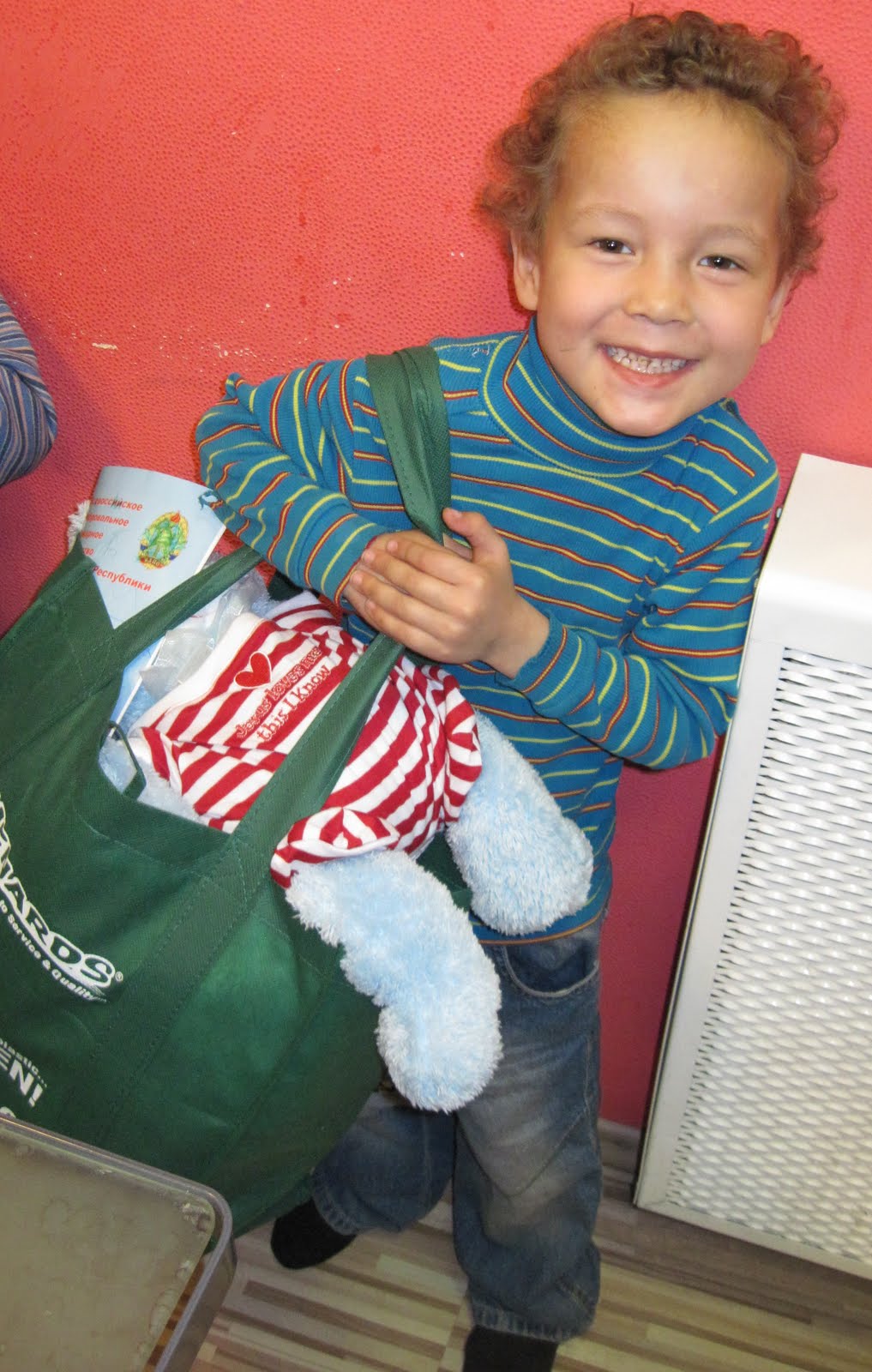
After more than an hour of questions, the kids get their gifts. Much energy is spent sorting through their bags, comparing contents, and displaying the loot. We derive as much pleasure watching their joy as they get in receiving. One Virginia family I’ve spoken with for over two years sends a wrapped gift for each unhosted child, along with a card. The kids know they should open the card before the accompanying gift. Each asks Irina to read theirs to them, and they listen with rapt attention.

By the time we leave for lunch at MuMu, the 10% chance of rain Moscow meteorologists predicted has become a 100% chance. There aren’t enough ponchos to go around, so Igor and Vladimir share. After eating, we find the Ferris wheel commemorating Moscow’s 850th anniversary operating, even in the inclement weather. It costs about $8 for one revolution, but we enjoy a view of Moscow its birds would envy. Unassuming Alexandra is so giddy to board that she pushes Joyce, her host, through the turnstile. She wears a nonstop grin the entire ride that Joyce claims was worth the cost of all our tickets. With the child so hesitant to assert herself, I am thrilled we did something she enjoyed.

After the ride, we visit an old park next door built to exhibit the agriculture and industry of the Soviet Union. Now its eighty-odd pavilions mainly house small shops, but it’s still a weekend destination for Muscovites. At the Friendship of the Peoples fountain, sixteen gilded maidens, each dressed in a costume of a different former Soviet republic, circle sheaves of wheat. The fountain, on a list of the ten most beautiful in the world, aimed to honor the bond of friendship between the republics, united under the glories of communism. While the fountain isn’t running today due to rain, and the union it celebrates has collapsed, we still find it worthy of its top-ten billing.

Some of the kids have a few rubles for the trip. I don’t know where they got them, but assume they’re from the summer foster families. Zulya is itching to spend hers, and after the Ferris wheel we pass carnival games. A man is chanting into a megaphone, though we’re the only ones here. Zulya pulls me aside and insists on playing his game. I think it’s a waste, but when she wins a Russian-speaking stuffed cow, her joy is boundless, and she shows it to everyone. The last day she is still clinging to it, and even I must admit the happiness she’s derived exceeds in value whatever she spent to win it.

Back in the metro, Simon is clutching Sergei’s hand. Inside, an elderly woman, box at her feet, holds a corrugated cardboard sign. As the rest of our band moves toward the escalator, Sergei pulls Simon back. Simon counters, wanting to stay with the group. Sergei resolutely refuses to budge until he has reached into his pocket, pulled out his rubles, and dropped some in the lady’s box. Simon is very moved by Sergei’s generosity. Though little in this world is his, he fights to share what he has. His teacher extolled his “nice soul”, and it’s shining through here.

We eat dinner at the hotel, then some of the kids ask to play in the rain at a playground. Every fiber of my being screams “Nyet!,” but when they ask me to take them, I hear myself agreeing. Igor marks the way with sidewalk chalk, so we won’t have trouble finding our way back. Both my compassion and my skimpy Russian restrain me from telling him it’s unnecessary, as I have a very good sense of direction. Two cats watch us out a screened window along the way; I love cats and instinctively call, “Here, Kitty, Kitty, Kitty!” several times, mesmerizing the kids. The next morning they tell Irina and insist I demonstrate my cat-calling prowess to her.

When we’re done at the park, I retreat exhausted to my room. Exhaustion is reassuring, like a report card, that I poured everything into my mission today. It’s been a profitable gleaning of insights into the kids’ personalities, details I hope will help me help them. Sinking into sleep, I revel in how Sergei’s kind gesture in the metro enriched us all.

I hope he is repaid a thousand-fold.


Wednesday, April 21, 2010

Faith

Monday morning, my inner night owl awakens with a grudge, as I gradually become aware of a din in the hall. I hear the word “explosion”, remembering with a start the Coca Cola I forgot in the freezer overnight. Rolling out of bed and slinking from my room to clean up the mess, I overhear a most alarming exchange between the receptionist and a host. Retreating, I go online to find a suicide bomber attacked the metro one-half mile from our hotel twenty minutes ago; at least fourteen people at our station are dead, and scores more injured. I grieve the senseless loss of life in a tragedy that feels more real by its proximity, knowing leaving that station was almost the last thing I did Sunday night. Suddenly, I panic, realizing Faith isn’t here. She planned to come early for gift distribution before our trek to Red Square. I can’t find my phone, and I’m frantic to call her, now. My terror, real, is short-lived, as I bolt out my door to find her arriving. I hug her tightly, overjoyed she’s alright. Delayed visiting with family on Skype, she left her flat later than intended. Arriving at our station to find mind-numbing carnage, she’d missed the explosion by fifteen minutes. The scene left her shaken, and quick to obey the barked command, “Leave the station now!” Outside, ambulances queued to transport the injured, as helicopters hovered overhead.

Hope, the Lighthouse Project director, is drifting off to sleep in the States when she hears the news on the radio. Having lived in Moscow many years, it’s a second home, with many Muscovites dear friends. I e-mail her immediately to confirm our safety, but she is so distraught she calls Faith anyway to be sure.

While the devastation sinks our plans, we don’t burden the kids with the news. After breakfast, Faith shepherds them aside, where she reads from a treatise on Moscow’s history. Meanwhile, the hosts and I organize piles of clothes, toys, school supplies, and treats. The tendency is to spoil orphans, and each of us is caught red-handed. Based on my own kids’ experiences, I have cynically warned families to avoid presents with sentimental value. Older children might retain some items, but younger children, or those at less-endowed orphanages, will likely keep nothing, the gifts becoming communal property, at best.

When Faith finishes her lesson, the kids bound into the common room to tell us about their orphanages, schools, chores, meals, and classwork. Elena, fifteen, on her first trip after a quintet of attempts to find a host, calls her orphanage more spacious than others. She beams describing the beautiful curtains the teachers sewed, and raves about the food, singling out the omelets for accolades. (Hopeless?, 10/6/09)  Anastasia, twelve, is less effusive in praise of her orphanage, one for delayed kids and not as welcoming as Elena’s. She attends school in the orphanage, and claims the food doesn’t matter. I expect compelling blog fodder when Faith queries them about their dreams, but impatient eyes are on the gifts. The conversation stalls when Erik, four, dreams of owning a cow, promptly countered by Artem, five, and his dream of a horse. Faith adjourns with, “They deserve some presents. Can I announce them?”

Four kids go hostless, brought in hope I’ll learn enough to promote them more winsomely next time. I gift these kids. Vladimir, ten, politely accepts, but I wonder if Sasha, a three-trip veteran from Vladimir’s orphanage, has divulged that gifts from the coordinator is a harbinger of no forever family. The other kids are young enough that the significance of gifts from me is lost on them. Artem, five and HIV-positive, is overjoyed with his haul. The cherubic tyke thanks me with an angelic “Spaciba!” and heaves the bag to his shoulder. He is so little that he lists perilously; even so, it is with effort that the chaperone cajoles him to release the bag; I have never seen a child so pleased by a windfall. Yuliana, like Artem five and HIV-positive, plows through the crowd, resolutely dragging her bag behind her to her room, where she can sort the treasures.

After the kids have seen their gifts, we leave on foot. MuMu is on the lunch menu, after which we visit the Cathedral of Christ the Savior. Walls inscribed with names of Russia’s war dead line gold-ceilinged halls. The cavernous interior is illumined by candles and perfumed with their wax, but the church is new enough that its bold frescoes are untamed by soot. Devout babushkas in blue frocks and head scarves use paintbrushes to sweep wax drippings from brass candelabras. Some in our band light candles and pray, while I seek out a spot on the wall, made sacred my first trip, when darling Denis, ten, stumbled through a prayer in Old Russian unfamiliar to him. Faith gently guided him through the foreign words, clasping her hand to her heart as he whispered with a poignant passion. His family waits in the hotel with us now, leaving tomorrow on the train for their court appearance to complete his adoption. When I think of Denis, breathing life into an ancient devotion in this place, but now giddy in an orphanage asking incessant questions about the arrival date of his family, I meditate on God’s acceptance of what He calls “true religion”: care of widows and orphans.

An ornamented bridge joins the Moscow River’s banks behind the church. From it we revel in a spectacular view of the Kremlin, snapping pictures of myriad combinations of people. Behind us is a 315-foot tall statue depicting Peter the Great, the tsar who dragged a reluctant Russia westward culturally and the father of the Russian navy, at the helm of a ship. An almost-universally loathed part of the Moscow skyline, the statue is doubly incongruous here: the navy was never associated with the Moscow River, and Peter moved his capital from Moscow to St. Petersburg, his new eponymous city, in 1712. Wagging tongues claim the Russian-made behemoth was Christopher Columbus, but rejected by several American cities, remained here, undergoing metamorphosis into Russia’s greatest tsar.

On the route back, we patronize a small convenience store near the hotel. Two cats lounge on the windowsills, watching ice cream coolers with feline detachment. The store has three rooms; the overlap in merchandise between the rooms perplexes until one in our group gets a dressing down, Russian style, leaving room three, for room two, with unpaid merchandise. Only then does it become apparent that each room is a separate store run by an independent proprietor.

The hotel dashes my plans to blog tonight with the malfunction of the wireless connection. As reels of the morning’s events play out silently and endlessly on the television before me, I spend the next five hours in the common room, discussing adoption, travel, and children with host families, the parents-to-be of Denis and Lima, and Inna’s mom, who calls her October adoption of the fifteen-year-old “the best thing I ever did.”  (Lima, 1/16/09 and Struggling, 2/2/09)

When our little group left America, we left in faith. Hundreds of Lighthouse’s adoptive families, harkening to God’s call, have made the journey to Moscow in faith. Hundreds of Lighthouse children, with the courage to leave the known, and venture into the unknown for the promise of a better life, have made this same trip in faith. The Lighthouse Project has been guided by faith from its inception: We came in faith before, we’re here in faith now, and the good Lord willing, we’ll return in June with the same faith, and our friend Faith.

It’s always been by faith. Nothing’s changing now.


Thursday, April 8, 2010

Joy

Sunday morning we lose an hour to Daylight Saving Time. Attending church in a building with a magnificent Kremlin view, I’m humiliated by a farewell presentation that stretches 30 minutes and a moralistic lecture delivered by a man who screams much of his message. One in our band manages to nod off during this ear-splitting homily that leaves me with tinnitus long after the speaker has fallen silent.

Walking back, one girl vomits, another feels feverish, and a boy complains of headache, so some retreat to the hotel to recuperate, while others of us wander Arbat, Moscow’s pedestrian-only street. We lunch at MuMu, an inexpensive cafeteria-style eatery, serving Russian food on dishes patterned after Holstein cow spots. The food is delicious, the stone and timber décor atmospheric, the music sprightly, and the dining area jammed with Muscovites. It’s a hit with our Lighthouse families; every subsequent suggestion of the restaurant is met with a chorus of ayes. MuMu is the place I wish would branch out to Grand Rapids.

In the evening, we visit the eponymously-named Nikulin Circus. A bronze statue of the renowned actor and clown Yuri Nikulin stands outside the pavilion; Faith claims that by rubbing his nose, we’ll become the funniest people in the world. Doug, a host dad, rubs it vigorously, then subjects us to jokes just as corny as before. Inside the arena, fluted columns support the ceiling, obstructing our view while lending the venue an air of sophistication. Though attendance hardly justifies it, every show we’ve been to on our trips has included live orchestra; Russians take their performing arts seriously. As a lover of Equidae, I’m charmed by a humble donkey, plodding heedless of the urging of his driver. As warranted, the performers stay clothed, though a clown in an ankle-length fur coat loses part of his outerwear as he parades around the ring. When the collar springs to life by a fox’s leap to the ground, shadowed by thirty ferrets jumping from the body in unison, the coat is creatively transformed into a PETA-approved style. I leave this circus satisfied we’ve done nothing to compromise the morals of our orphans. As we exit, Faith insists on a group photo by a portrait of the beloved Nikulin, whom she extols for his clean, kind humor and love of children.

We get back late, but I talk several families into venturing out to Eliseevsky’s, my favorite Moscow store. Tracy, a blog aficionado, is anxious to shop there, knowing how I love it. While the edifice is reliably grandiose, I’m disappointed to find them out of chocolate croissants, so I splurge on a consolation box of baklava instead. Successfully navigating the metro as a group without a bonafide Russian speaker, we arrive back home just after midnight. Delving into the baklava in the sanctity of my room, I am horrified to find the bottom blackened. Burned baklava stokes my generosity, stripping me of the gluttonous desire to wolf it down myself.

As I puzzle over how to unload my baklava without throwing it away, a host family taps on my door, ending the reverie. We end up visiting until just after 4:00 a.m., discussing kids they’re considering adding to their family. Having been blessed so richly by my own children of the world, being part of the conversation with other families considering adoption is unadulterated joy.

Joy, at any hour.


Tuesday, November 3, 2009

Golden Arches, Golden Domes

In Russia: Day 6

Bleary-eyed and dragging, my host families from Michigan, Oklahoma, Indiana, and Illinois file into the hotel at about 1:00 p.m. on Friday. Even after the flight and the 7-8 hour time change, they’re anxious to meet the kids, who've been waiting almost six hours. The meeting lacks the customary fanfare of a US trip because all of us, kids and families, have traveled overnight, but it’s just as well we skip the drama since half the kids lack official hosts. Shortly afterward, we tackle the day’s sightseeing. Without the introduction of who goes with whom, it’s interesting to see how families and kids pair up on our walk, and how kids flit from family to family, in an apparent attempt to cover their bases. It’s a foreign dynamic compared to previous trips. Since I don't have other potential adoptive families to draw from this time, I worry at first when the “wrong” child is with the “wrong” parent, but eventually decide it doesn’t matter if everyone notices all the kids. An added benefit: it is less obvious which kids don’t have families this way. While I’m far from happy about the host to orphan ratio, watching how everyone is soon comfortable with everyone else, I realize this idea was a sheep in wolf’s clothing.

Scarcely out of our hotel, we turn left on the busiest street in Moscow, just in time to see the street closed off and a motorcade of black Mercedes limousines sandwiched by a phalanx of motorcycles speeding down the road. Faith says it’s the president of Russia, Dmitry Medvedev, and commands us to wave. We do, but his tinted windows keep us from knowing if he reciprocates. He’s returning home to the Kremlin, just down the road from where we’re staying. Faith claims the kids are celebrities now that they’ve seen a car holding such an important person, but they don’t believe her.

We’re hungry. Plans to visit Moscow’s only authentic pizza restaurant fizzle, but we spot a restaurant marked with golden arches on our way. The kids vote to eat there, but when we enter, the place is so busy there’s nowhere to sit. We end up at MuMu instead, an atmospheric joint specializing in Russian food like pelmini and borscht. It’s delicious, but the kids would prefer something a little more American.

We wander Arbat Street, Moscow’s pedestrian promenade, lined with little shops selling matryoshka dolls, trinkets, and Russian kitsch. We pass a shriveled old woman wearing a sandwich board incongruously advertising tattoos. In our sleep-deprived delirium, nobody buys anything, and nobody gets a tattoo.

At the end of the road, we see the golden domes of the Cathedral of Christ the Savior. The largest church building in Russian Orthodoxy, the original cathedral on the site was built to commemorate Napoleon’s departure from Russia, and consecrated in 1883. In 1931, Stalin issued an edict, leading to the church's destruction. Plans called for an audaciously monstrous “Palace of the Soviets” to be built there. Blueprints crowned the structure with a garish statue of Lenin over 300 feet tall, but instability in the ground due to the nearby Moscow River rendered the plan untenable, and the project was abandoned. In its place, the world’s largest open-air swimming pool was built. Faith and Dima fondly reminisced swimming there, playing hide and seek in the steam of the pool on savagely frigid days. They had mixed emotions when, after the collapse of the Soviet Union, the pool was demolished and the church faithfully reconstructed according to original specifications.

Darkness falls early in Russia, and after the cathedral, we call it a day, boarding a bus back to the hotel. Faith tells the driver the children are orphans, so he lets them ride without a ticket. As we thaw at home, parents work together in the kitchen, creating a scene of domestic bliss while the kids play behind us. Ramen noodles and pickles are dinner. It isn’t fancy fare, but it beats beets and white meatloaf. As I retreat to my room to write, the same sensation I always have when kids arrive floods my psyche. I know I’ve done all I can for this moment, it’s here, and it’s time to see what God has in store for the kids and their futures. I’m praying that it’s something special.

My head hits the pillow at 3 a.m. I sleep quickly, but not before mulling a smidgen about how privileged I am to play a role, and how honored to be entrusted with a first stab at this unfolding, grand adventure.

See video here.