Showing posts with label Cathedral of Christ the Savior. Show all posts

Friday, September 24, 2010

Going With Them

Day three of the kids’ visit, my little band lacks the ambition of the first day and the urgency of the last. While I am gung-ho to show them more of the city, yesterday was a gumption-robbing scorcher, and today is a carbon copy. The families opt to stay in climate-controlled comfort with the kids, but after our late laugh last night, we Americans arrive at the kids’ flat almost an hour later than planned.

We’re throwing a party, and since it’s no one’s birthday, we pretend it’s everyone’s. In a departure-eve tradition at my house, my Russian son measures out streamers twice the length of our playroom and rolls them up as I finalize my packing. He enjoys surprising me with the color, and it lets him do something to help “the Russian kids,” as he calls them. Russian ceilings tower, and hanging my son’s streamers high enough always proves challenging. The festivity gauge rises sharply when I give the kids balloons; soon some joust with inflatable swords, some decorate the flat, and others fashion gaudy headwear for the partygoers.

Svetlana, the chaperone, is polite, but not exactly jovial. She’s claimed several times this week the kids aren’t interested in things they’re yanking my arms for, ensured the television drones endlessly, and made clear that on this, her inaugural visit to Moscow, the only thing she cares if she sees is the Cathedral of Christ the Savior. When she accepts and dons a hat designed by one of our budding haberdashers, I extend shocked and silent kudos, as it would hurt my heart to see an orphan’s generosity rebuffed.

As the festive melee unfolds, I pour over two bird’s milk cakes. I expect to write “Happy Birthday” and the kids’ names in Cyrillic, but the tubes of frosting I’ve brought are almost pathologically uncooperative. Before I get to the end of “Happy Birthday,” I’m lamenting the beautiful vision in my mind is destined to remain only that, until Zulya comes to look, hugs me, and proclaims it beautiful. I recognize her word in Russian, and the delivery is so genuine I can tell she means it. I think it strange that her single word agitates a flurry of emotions within me. I cherish her encouragement, but find it sad commentary that my eyesore of a cake is lovely to her. It highlights why we have a party when it’s no one’s birthday, and even why we run these trips: the kids have been denied most things we assume are birthrights of childhood.

I plant Hanukkah candles on the cake. They were on clearance, and I can’t resist a bargain. As a bonus, they’re more substantive than ordinary birthday candles. We always sing “Happy Birthday” several times for our videos, and shoot enough photos to shame paparazzi; ordinary candles cannot withstand such delay. As the candles burn brightly through all the pictures and songs, no one suspects that they’re not officially birthday candles.

During my first Russian party, I learned to set aside one cake for the kids to blow on and eat, reserving another cake for those favoring dessert unsullied by spittle. After English and marginal Russian renditions of the birthday song, the candles are extinguished by eight kids blowing in near-unison, and the cake is cut. Each child’s piece sports a candle, which we relight to their jubilation. As some kids eat around the flame with shaky hands, and others wield theirs, I wonder what we’d be charged for burning down the flat.

After cake, it’s Pin the Tail on the Donkey time. The kids haven’t played it before, though you’d never know by the skill with which they cheat: only two don’t grope the wall before committing their tails. Even the translator and chaperone feel around. For a low-stakes party game without a prize, the depth of my indignation surprises me. At the end, having no photo, I pick Alexandra, a non-cheater, to reenact the game. She now pats the wall, too, having modified her strategy while watching the others. We Americans play afterward, demonstrating how it’s done. None of us cheat, and the kids laugh like we’re the greenhorns.

A boulevard outside the flat offers a tree-lined walk down the center, with a playground near one end. After the party and lunch, we lug a watermelon and freezer pops to the playground, availing ourselves of a thousand photo ops the kids create. Oleg bats as Jeff pitches him a baseball, Alexandra sits on a slide with Barrie and Joyce, Sergei and Andrei look at pictures, and Zulya and Lora throw a Frisbee. A man and his tiny daughter walk by. The little one is fascinated by the Frisbee, so Zulya squats down, shows her the disc, tries to help her throw it, and speaks gently to her. For a child on the receiving end of so little nurture in her life, it is heartwarming to see how naturally Zulya doles it out.

At the park, translator Irina summons Alexandra; Barrie and Joyce want to talk with her. As she sits beside them on a bench, they tell her she’s beautiful, they love her, and they want her to be their daughter. They flip together through an album with pictures of their family, home, and their son Trevor with a boy he’s adopting from our March trip. Presenting her a necklace with a cross pendant, Joyce shows Alexandra a similar necklace she received from her mom. Alexandra says she likes Barrie and Joyce, but isn’t sure about adoption. That’s okay, they counsel. They want her to consider it, to be sure.

As the rest of the kids play on, oblivious to the momentous discussion near them, I slice the watermelon with a knife I thought twice about carrying down the street. Russians are proud of the watermelons they call “ar-BOOSE.” Since this is my first summer trip, it’s my first taste. Their pride is justifiable, and the watermelon is a most apt treat on this sweltering, but gloriously smoke-free, afternoon.

At night, when I’m unwinding back in my room, Barrie and Joyce knock on my bag door, wanting to talk. They have been trip stalwarts, unfailingly upbeat whether or not circumstances warrant. Having them along has been unmitigated pleasure. They touch me by opening with effusive thanks, then one-up themselves with the tale of their conversation with Alexandra at the park. Later at the flat, Irina tells Joyce Alexandra wants to join their family, but is too shy to tell them. Weeping, Joyce invites Barrie to meet his new daughter. It’s impossible to contain his emotion as he promises Alexandra his lifelong love and protection. He adds, just to me, that he was warned adoption was pricey.  He understands, but invoking the "you can't take it with you" expression, counters that they can take their kids with them someday.

So in a humble room, behind a makeshift trash bag door, I learn the joyous tidings that Alexandra, the first orphan I ever interviewed, has a family, and one I esteem (Mission: Never Accomplished, 2/10/10). As Barrie and Joyce thank me again for helping them find their daughter, it’s worth a hug and a tear. Or two.

Alexandra is going with them.


Wednesday, April 21, 2010

Faith

Monday morning, my inner night owl awakens with a grudge, as I gradually become aware of a din in the hall. I hear the word “explosion”, remembering with a start the Coca Cola I forgot in the freezer overnight. Rolling out of bed and slinking from my room to clean up the mess, I overhear a most alarming exchange between the receptionist and a host. Retreating, I go online to find a suicide bomber attacked the metro one-half mile from our hotel twenty minutes ago; at least fourteen people at our station are dead, and scores more injured. I grieve the senseless loss of life in a tragedy that feels more real by its proximity, knowing leaving that station was almost the last thing I did Sunday night. Suddenly, I panic, realizing Faith isn’t here. She planned to come early for gift distribution before our trek to Red Square. I can’t find my phone, and I’m frantic to call her, now. My terror, real, is short-lived, as I bolt out my door to find her arriving. I hug her tightly, overjoyed she’s alright. Delayed visiting with family on Skype, she left her flat later than intended. Arriving at our station to find mind-numbing carnage, she’d missed the explosion by fifteen minutes. The scene left her shaken, and quick to obey the barked command, “Leave the station now!” Outside, ambulances queued to transport the injured, as helicopters hovered overhead.

Hope, the Lighthouse Project director, is drifting off to sleep in the States when she hears the news on the radio. Having lived in Moscow many years, it’s a second home, with many Muscovites dear friends. I e-mail her immediately to confirm our safety, but she is so distraught she calls Faith anyway to be sure.

While the devastation sinks our plans, we don’t burden the kids with the news. After breakfast, Faith shepherds them aside, where she reads from a treatise on Moscow’s history. Meanwhile, the hosts and I organize piles of clothes, toys, school supplies, and treats. The tendency is to spoil orphans, and each of us is caught red-handed. Based on my own kids’ experiences, I have cynically warned families to avoid presents with sentimental value. Older children might retain some items, but younger children, or those at less-endowed orphanages, will likely keep nothing, the gifts becoming communal property, at best.

When Faith finishes her lesson, the kids bound into the common room to tell us about their orphanages, schools, chores, meals, and classwork. Elena, fifteen, on her first trip after a quintet of attempts to find a host, calls her orphanage more spacious than others. She beams describing the beautiful curtains the teachers sewed, and raves about the food, singling out the omelets for accolades. (Hopeless?, 10/6/09)  Anastasia, twelve, is less effusive in praise of her orphanage, one for delayed kids and not as welcoming as Elena’s. She attends school in the orphanage, and claims the food doesn’t matter. I expect compelling blog fodder when Faith queries them about their dreams, but impatient eyes are on the gifts. The conversation stalls when Erik, four, dreams of owning a cow, promptly countered by Artem, five, and his dream of a horse. Faith adjourns with, “They deserve some presents. Can I announce them?”

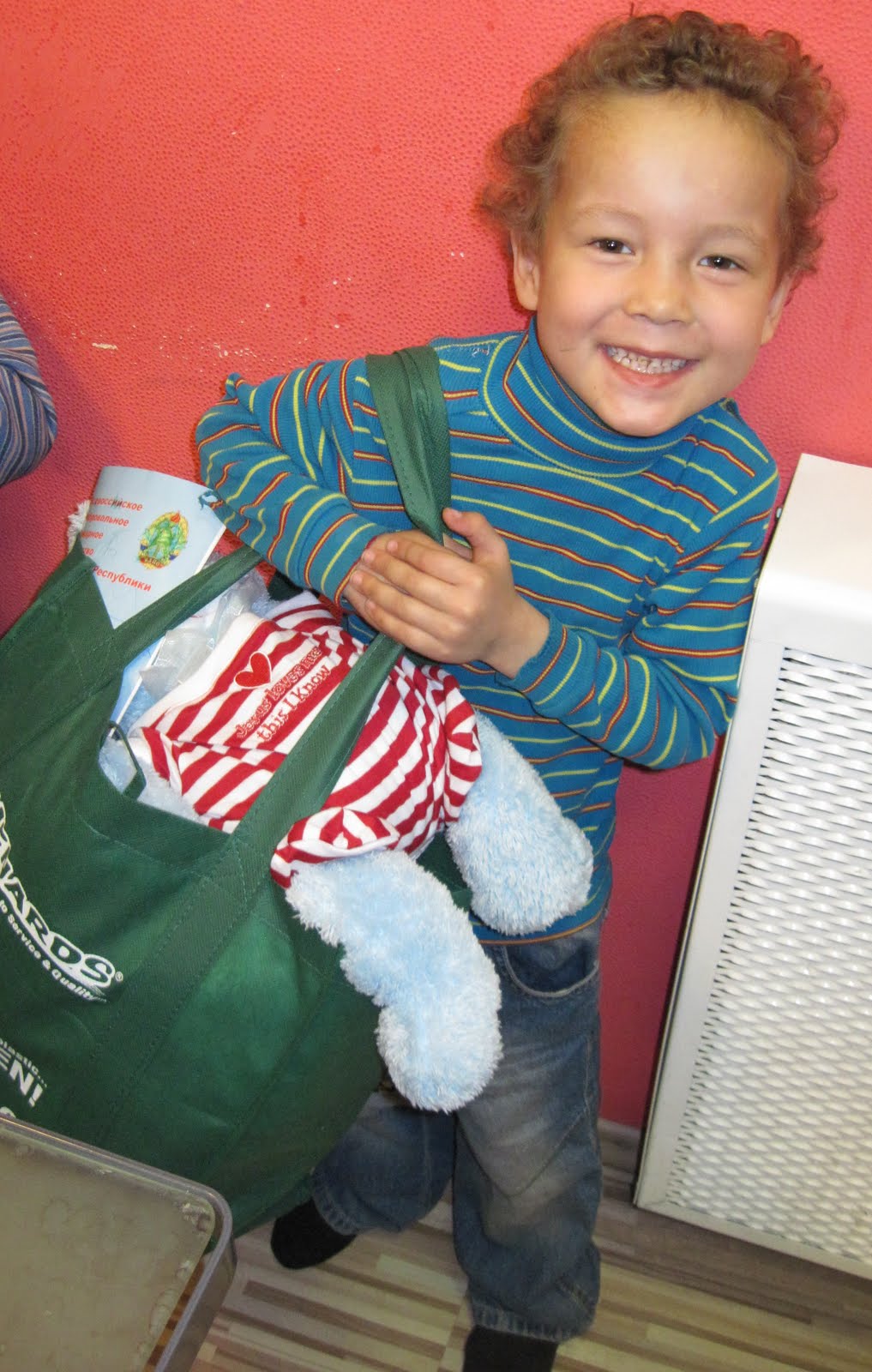
Four kids go hostless, brought in hope I’ll learn enough to promote them more winsomely next time. I gift these kids. Vladimir, ten, politely accepts, but I wonder if Sasha, a three-trip veteran from Vladimir’s orphanage, has divulged that gifts from the coordinator is a harbinger of no forever family. The other kids are young enough that the significance of gifts from me is lost on them. Artem, five and HIV-positive, is overjoyed with his haul. The cherubic tyke thanks me with an angelic “Spaciba!” and heaves the bag to his shoulder. He is so little that he lists perilously; even so, it is with effort that the chaperone cajoles him to release the bag; I have never seen a child so pleased by a windfall. Yuliana, like Artem five and HIV-positive, plows through the crowd, resolutely dragging her bag behind her to her room, where she can sort the treasures.

After the kids have seen their gifts, we leave on foot. MuMu is on the lunch menu, after which we visit the Cathedral of Christ the Savior. Walls inscribed with names of Russia’s war dead line gold-ceilinged halls. The cavernous interior is illumined by candles and perfumed with their wax, but the church is new enough that its bold frescoes are untamed by soot. Devout babushkas in blue frocks and head scarves use paintbrushes to sweep wax drippings from brass candelabras. Some in our band light candles and pray, while I seek out a spot on the wall, made sacred my first trip, when darling Denis, ten, stumbled through a prayer in Old Russian unfamiliar to him. Faith gently guided him through the foreign words, clasping her hand to her heart as he whispered with a poignant passion. His family waits in the hotel with us now, leaving tomorrow on the train for their court appearance to complete his adoption. When I think of Denis, breathing life into an ancient devotion in this place, but now giddy in an orphanage asking incessant questions about the arrival date of his family, I meditate on God’s acceptance of what He calls “true religion”: care of widows and orphans.

An ornamented bridge joins the Moscow River’s banks behind the church. From it we revel in a spectacular view of the Kremlin, snapping pictures of myriad combinations of people. Behind us is a 315-foot tall statue depicting Peter the Great, the tsar who dragged a reluctant Russia westward culturally and the father of the Russian navy, at the helm of a ship. An almost-universally loathed part of the Moscow skyline, the statue is doubly incongruous here: the navy was never associated with the Moscow River, and Peter moved his capital from Moscow to St. Petersburg, his new eponymous city, in 1712. Wagging tongues claim the Russian-made behemoth was Christopher Columbus, but rejected by several American cities, remained here, undergoing metamorphosis into Russia’s greatest tsar.

On the route back, we patronize a small convenience store near the hotel. Two cats lounge on the windowsills, watching ice cream coolers with feline detachment. The store has three rooms; the overlap in merchandise between the rooms perplexes until one in our group gets a dressing down, Russian style, leaving room three, for room two, with unpaid merchandise. Only then does it become apparent that each room is a separate store run by an independent proprietor.

The hotel dashes my plans to blog tonight with the malfunction of the wireless connection. As reels of the morning’s events play out silently and endlessly on the television before me, I spend the next five hours in the common room, discussing adoption, travel, and children with host families, the parents-to-be of Denis and Lima, and Inna’s mom, who calls her October adoption of the fifteen-year-old “the best thing I ever did.”  (Lima, 1/16/09 and Struggling, 2/2/09)

When our little group left America, we left in faith. Hundreds of Lighthouse’s adoptive families, harkening to God’s call, have made the journey to Moscow in faith. Hundreds of Lighthouse children, with the courage to leave the known, and venture into the unknown for the promise of a better life, have made this same trip in faith. The Lighthouse Project has been guided by faith from its inception: We came in faith before, we’re here in faith now, and the good Lord willing, we’ll return in June with the same faith, and our friend Faith.

It’s always been by faith. Nothing’s changing now.


Tuesday, November 3, 2009

Golden Arches, Golden Domes

In Russia: Day 6

Bleary-eyed and dragging, my host families from Michigan, Oklahoma, Indiana, and Illinois file into the hotel at about 1:00 p.m. on Friday. Even after the flight and the 7-8 hour time change, they’re anxious to meet the kids, who've been waiting almost six hours. The meeting lacks the customary fanfare of a US trip because all of us, kids and families, have traveled overnight, but it’s just as well we skip the drama since half the kids lack official hosts. Shortly afterward, we tackle the day’s sightseeing. Without the introduction of who goes with whom, it’s interesting to see how families and kids pair up on our walk, and how kids flit from family to family, in an apparent attempt to cover their bases. It’s a foreign dynamic compared to previous trips. Since I don't have other potential adoptive families to draw from this time, I worry at first when the “wrong” child is with the “wrong” parent, but eventually decide it doesn’t matter if everyone notices all the kids. An added benefit: it is less obvious which kids don’t have families this way. While I’m far from happy about the host to orphan ratio, watching how everyone is soon comfortable with everyone else, I realize this idea was a sheep in wolf’s clothing.

Scarcely out of our hotel, we turn left on the busiest street in Moscow, just in time to see the street closed off and a motorcade of black Mercedes limousines sandwiched by a phalanx of motorcycles speeding down the road. Faith says it’s the president of Russia, Dmitry Medvedev, and commands us to wave. We do, but his tinted windows keep us from knowing if he reciprocates. He’s returning home to the Kremlin, just down the road from where we’re staying. Faith claims the kids are celebrities now that they’ve seen a car holding such an important person, but they don’t believe her.

We’re hungry. Plans to visit Moscow’s only authentic pizza restaurant fizzle, but we spot a restaurant marked with golden arches on our way. The kids vote to eat there, but when we enter, the place is so busy there’s nowhere to sit. We end up at MuMu instead, an atmospheric joint specializing in Russian food like pelmini and borscht. It’s delicious, but the kids would prefer something a little more American.

We wander Arbat Street, Moscow’s pedestrian promenade, lined with little shops selling matryoshka dolls, trinkets, and Russian kitsch. We pass a shriveled old woman wearing a sandwich board incongruously advertising tattoos. In our sleep-deprived delirium, nobody buys anything, and nobody gets a tattoo.

At the end of the road, we see the golden domes of the Cathedral of Christ the Savior. The largest church building in Russian Orthodoxy, the original cathedral on the site was built to commemorate Napoleon’s departure from Russia, and consecrated in 1883. In 1931, Stalin issued an edict, leading to the church's destruction. Plans called for an audaciously monstrous “Palace of the Soviets” to be built there. Blueprints crowned the structure with a garish statue of Lenin over 300 feet tall, but instability in the ground due to the nearby Moscow River rendered the plan untenable, and the project was abandoned. In its place, the world’s largest open-air swimming pool was built. Faith and Dima fondly reminisced swimming there, playing hide and seek in the steam of the pool on savagely frigid days. They had mixed emotions when, after the collapse of the Soviet Union, the pool was demolished and the church faithfully reconstructed according to original specifications.

Darkness falls early in Russia, and after the cathedral, we call it a day, boarding a bus back to the hotel. Faith tells the driver the children are orphans, so he lets them ride without a ticket. As we thaw at home, parents work together in the kitchen, creating a scene of domestic bliss while the kids play behind us. Ramen noodles and pickles are dinner. It isn’t fancy fare, but it beats beets and white meatloaf. As I retreat to my room to write, the same sensation I always have when kids arrive floods my psyche. I know I’ve done all I can for this moment, it’s here, and it’s time to see what God has in store for the kids and their futures. I’m praying that it’s something special.

My head hits the pillow at 3 a.m. I sleep quickly, but not before mulling a smidgen about how privileged I am to play a role, and how honored to be entrusted with a first stab at this unfolding, grand adventure.

See video here.