Tuesday, February 28, 2012

Peppered With Joy

Alexei in his orphanage
Tammy and her husband were childless and interested in adoption, but had never really considered the adoption of an older child. She traveled with an early Reverse Lighthouse Project trip to Moscow, where she fell in love with 12-year-old Alexei.  After a rather circuitous adoption process, they welcomed Alexei home in 2011.  In mid-February 2012, Tammy spoke with me, bubbling about life with their new son.

It is important to note that while we are delighted that this has been a very joyous adoption, and we here at the Lighthouse Project always hope, pray, and work toward such positive outcomes, we also recognize that many adoptions of older children will have substantially more difficulties than this family has experienced.

Russian Orphan Lighthouse Project (LH):  How did you and your husband come to adopt an older boy from Russia when you were looking at a younger girl from China?

Tammy: We were scanning the entire world for orphans and their plight, and spending lots of time in prayer. Your blog just happened to be one of our nesting grounds. You posted a kiddo with an “I’m a Pepper” t-shirt on the very same day I was on the edge of attending a Lighthouse Project trip (Peppered With Love, 9/28/09). Not for adoption, of course, as I had no clue where our kiddo would come from!

I went to a women’s conference to drop off CDs. My friend pushed me to stay. Wrestling with this decision to go to Russia or not, I sat in the red velvet church pew, kind of praying and listening, but not all there. I whispered, "Well, God, I will go to Russia, but I am not sure why You would really plan an adoption in the most expensive, unfamiliar, and barely pleasant country.” Remember, I had been to 13 different countries, so in my all-knowing brain I was sure our little seed from heaven would be from one of "those countries." At the moment I finished my half-hearted prayer with a promise, I did the worst thing: I asked for a sign from God for confirmation.  My friend’s little girl tapped me on the shoulder and gave me a can cooler to hang onto. It said, "I’m a Pepper."

Then in Russia I met Alexei. I put gloves on his hands, and he looked at me with those big blue eyes, and I didn't see an older child at all or an orphan, I just saw my son. Age was just a number.

LH: Did you have any fears before your adoption which actually came true?

Alexei meets a friend's baby
Tammy: I worried about him being homesick. It has happened twice since he’s been home.  He’s not inconsolable, but he’ll want us to be close.  He just cries, then gets over it. I worried he’d miss his culture and country, and it has come true. It hasn’t been terrible, but I feared him being sad even once, and he was.
LH: What challenges did you face when you brought Alexei home?

Tammy: The biggest was communication right away at deeper level. I think he would say that, too, being an older child and knowing his language.  Then coming here, and language learning has to start all over again.  Since communication does have to come slowly, it gives time for relationship to build slowly and naturally, so that was good.  But we wanted to comfort him with words, and we just had to hold him, or cook something we thought might comfort him. We really haven’t had other challenges.
LH: Communication is a common concern of pre-adoptive families, but our staff frequently thinks language is lower on the list of challenges, as compared to some of the behavioral issues older kids can come with. Is your thought on communication being your biggest challenge a reflection of the level of difficulty not sharing a language caused, or a reflection on the ease of your overall adoption?
 
Alexei and his dad
Tammy: From day one he has been easy to comfort.  He does not do a lot of negotiating, just does what he needs to do. At about four months we were able to make jokes and laugh about the same things and understand things together. There were no other challenges that we have had, so I think it’s more a reflection on the ease of our adoption.

LH: How did you handle the language challenge?

Tammy: I prayed a lot, prayed a lot to deal with it.  We tried to learn Russian and tried to use it, so he would understand we were trying. It was really just a challenge because we wanted to know him better, and know him faster. We needed to talk to do that, but we couldn’t do it right away. It wasn’t bad, but you have to be really patient, you have to be creative.  We were playing board games, reading the Bible in two different languages.  If he looked low or sad, we would leave and go on vacation or play a game or make him a different kind of food. When we were on vacation, we didn’t have to struggle to communicate as much because we weren’t on any regimen, just a relaxed and laid-back vacation. We always offered a translator, but Alexei felt more comfortable talking to a girl he knew from the orphanage who had been in America longer. Sometimes he didn’t want to do that, but sometimes having someone talk to him in Russian just put him at ease. He would talk to his Russian grandma on Skype, too. 
LH: How has the transition been compared to what you expected?

Tammy: Much easier. We took all the adoption classes, and took everything with a grain of salt, but realized maybe he’d have behavior problems, or he wouldn’t attach.  Our first two weeks home I woke up every day at 6:30 a.m., went for walk, and prayed about all my fears. When I got home I left my fears at the door, and just went in to love him and be his mom.  The classes and other adoptive families prepared us enough to make us aware of what could happen. Knowing those things, our transition was much easier than we expected.
LH:  What joys have you had?

Tammy: How long have you got?  Everything! Alexei is very affectionate, just hug, hug, pull us in and hug us. That’s the most important thing! And we have this very tall boy wanting to make sure we don’t forget to hug each other. He did not expect anything of us, and never said, “Why don’t I have this?”  He loved us for who we were.  I could see that in how he acted: he makes us cards, writes us messages, he’s willing to be open and honest, he’s not withdrawn. He was open to saying “I love you” the first day he got home, and he physically showed us he loved us from the first day. We didn’t expect that, but we got it! I did not expect his immediate acceptance of us as his parents from an older child; I expected a friendship first, but he loved us as parents. We could see it in his actions, and I loved that.
LH: What advice would you give to other families considering older child adoption?

Alexei with his dad
 Tammy:  I don’t think there is less joy and love just because they’re older; it’s so strong!  I wasn’t there the years when he was little.  But I don’t wish I knew him when he was a baby, because I just feel like he was always mine.  Don’t look at it as “I only have them a few years as compared to a baby.” That’s impossible to measure until they’re in your arms and in your home.  Alexei is no less precious because he’s older. Don’t hold back! Sometimes you expect older kids to act 14 or 15, but they might be emotionally 7 or 8. If he wants to hug in the kitchen for 10 minutes, we let him. We don’t know what he missed, and he might need that. My advice? Expect to fall in love with them! Alexei is just as precious as if we had him when he was three or four.  My friend, an adoptive mom of several older Russian kids, told me to have no expectations. People think you wouldn’t hold your son’s hand when you’re talking to him, but don’t hold back. He values his family! Don’t hold back on loving him and enjoying being his parent.  Just because he’s older does not mean he doesn’t want you to sit in his room and play with him. If he’s this affectionate, why would we hold back?
LH: What has been the most fun you’ve had together?

Tammy: Bedtime!  Every night before bed we read and pray and then start tickling.  Only two nights since we’ve been home has it not happened.  It starts in his room, then moves to ours, then back to his. It’s just a riot, it’s everything, it’s a Hallmark commercial!  Then he’ll ask random questions because he doesn’t want to go to sleep, things like, “Why in English does it say this?”  It’s the most precious time for us, and a lot of fun.
LH:  What has been the hardest thing you’ve overcome so far?

Tammy: A lot of kids say, “In Russia…”   That’s one of the big things we’ve overcome together. It wasn’t a hard thing, but after hearing it 100 times per day…  We had to learn ourselves that we don’t know what it was like in Russia. Now we don’t worry about the “In Russia…” part.  Buildings are bigger there, ice cream is better there. In the transition, you as parents realize you don’t know Russia.  It could break their spirit to act like you don’t believe it, so we had to learn patience with cultural things. We overcame being bothered by it.  We never debated it with him, but we discussed it privately.  An adoptive mom told me when they stop doing it, you’ll miss it.  It was us overcoming it.  At first we were concerned if what he was saying about Russia was true, but then we realized it was more important to support him.  Those statements showed his love for his birth country more than if they were true or not. It was never a negative thing, but it’s just how sentences would start. You should be prepared that kids are going to talk about Russia a lot, and you are going to listen.
LH: Sometimes new adoptive parents do not “feel” like a family right away. Do you feel like a real family yet?

Tammy: Yes!  Absolutely.  I don’t know what it was like before he was here; it feels like he has always been here.  He and my husband do things alike.  I think it’s pretty funny.
LH: How has your extended family accepted Alexei?

Tammy: Overwhelmingly.  We had an interesting Christmas.  Everybody just showered him with affection.  Not just gifts, but time.  They wanted to take him places and show him things.  I almost had to tell them not to forget the other kids.  It was the same thing as a baby, only they could talk to the “baby” and teach him new things.  There was ten times the involvement because they could do things with him. It has been incredible; every single person on both sides has accepted him and fallen in love with him. It’s a miracle.  Everyone adores him. He gets letters every day from cousins and nieces and nephews. I expected it, because every day we tried to get him home, it was everyone’s heart desire.  Everyone is saying, “Wow!  What a wonderful experience! I expected a nephew, but never a nephew like this!”  It’s neat to see they love him more than they even knew that they would.
LH: What have you learned through this adoption?

Tammy: Every day Alexei is translating in his head because of language and cultural differences.  Every day he gets exhausted, and you can see it in his face, but he isn’t going to take a nap because he doesn’t want to let us down. One day he was upset and tired. Finally, he laid in his bed and cried. We went to him and told him, “We love you when you’re angry and when you don’t obey us. We’re doing this because it’s important for you. A good family loves each other and is there for each other. If you could communicate with us and tell us you’re tired…”   Us coming to him when he was upset, rather than just letting him be upset, shocked him. He couldn’t believe we loved him when he was angry. But a good family loves each other and forgives each other. When a child is upset, when you’re nurturing them into this relationship, I don’t think you should let them be upset; you should talk to them and let them know you’ll be there for them if they want to talk.  Bring them back into the family when they don’t know how to reconcile.  They don’t know how to fix a situation, because in their past people just walked away. We didn’t read this, it just happened. We did not want him to think we were staying angry with him, nor did we want him to stay angry with us. 
Also, just be patient, because they ask a lot of questions. Be patient and be available.

LH: What other things have been remarkable?
Tammy:  [The day] he started calling me Mom!  He called us our first names in Russia. Our hostess told him to call us Mom and Dad, but I told him to call me whatever he wanted. I struggled with it, but my husband said it’s just a title, and since he never had a mom, maybe he doesn’t know what it is.  I prayed about it and let it go.  After a few months, I woke him up one morning. I said, “Good morning, Alexei,” and he said, “Good morning, Mom!”  I said, “Mom?!”  He said, “Yeah, you’re my mom.  I love you, Mom.”  I told him he didn’t need to give me anything for Christmas!  When my husband got home, it was the same thing for him.  My husband asked, “Is he calling you Mom?”  And I just smiled and nodded.  It took some time for him to start, but I remember the exact day because it was very special to me, and he knows how much it means to me.  We let it come natural.  If it had never come, I would not have been disappointed, because I loved him like a mom would, and he was a wonderful son.  After about two months I let it go.  He acts like a son and he loves me like a son would, and actions speak so much larger than words.  I don’t think anyone should get hung up on it.

A lot of firsts with older kids you don’t realize you’re going to have, so it’s kind of neat.  Some people think they’re missing out by adopting older, but they’re communicating the things they experience for the first time with you.  You’re sharing it! When you adopt an older child it’s a very rich experience, and a profound experience to watch them heal, and to be a part of it.  Once he made a mess with some glow-in-the-dark powder, then he realized he shouldn’t have made it at his age.  But then he put it on my face and nose and we started laughing.  He started saying, “I’m sorry!” and cleaning all up, but I thought, “What did he ever get to do before this?”  There were things that he didn’t get to experience, and it’s a delight to share them with him.  Zero expectations.
They’ll surprise you with their joy! 
***
Thank you, Tammy, for sharing a bit of your joy with us!  All of us at the Lighthouse Project are thrilled for the three of you, and we wish you continued blessings as you continue to grow closer together in the coming months and years.

Sunday, February 12, 2012

Going To Be Extraordinary

Tim dislikes his wheelchair and seldom uses it, so it’s an ironic first impression I have of the 12-year-old being wheeled onto the YMCA stage to present a monologue he wrote himself. My friend Hope, director of the Lighthouse Project, ages ago lost track of exactly how many adoptions she’s done, though she pins the number at over 1,000. And after devoting her entire adult life to the work, this boy, a triple congenital amputee, has stolen her heart more than any other child she’s helped. 

She’d mentioned Tim before, only a snippet here or there, so it was a surprise a few days ago when she entreated me to attend a play of his in Chicago.  It’s an inconvenient 200 miles southwest on a weekend that already has me traveling north to a four-hour board meeting Saturday morning, then to a Sunday morning church adoption fair.  But before I could wield this iron-clad excuse, she reminded me that Tim was her most special adoption, ever. Hope always gives, and I’d yearned to reciprocate, but never had an inkling how.  So to honor her commitment to the orphans of Russia, not least of whom were my own two kids, I acquiesced and agreed to go with my family.
On the day of the play, I rush home from a most wearisome meeting. My husband and kids are waiting at the door, and they leap into the van without my ever shutting it off.  If we aren’t ensnarled in traffic, we should make the play, Relentless Is My Middle Name, with a half hour wiggle room. I don’t fritter away a second of the journey, finishing a photo sheet of kids seeking their families on our next Lighthouse Project trip, and speaking with several hosts and Hope, who’s worried we’ll be late.
Traffic parts like the Red Sea though, and we arrive even before the doors open.  Tim begins his production draped in black cloth, which is theatrically removed.  Lifted onto a podium, he recounts the story of his birth in Ukraine, adoption at age three from Russia, and life with his family as one of eleven children. His poise, humor, and transparency are mesmerizing, and make seeing him as a completely normal boy, just with one arm, effortless.

His biological mother was exposed to radiation near Chernobyl, he tells us. Though many children from the area suffer anomalies, she was young, and unprepared to parent him. Somehow, Tim left Ukraine and ended up in a baby house north of Moscow. Besides life, her only gift to him before relinquishing him to the orphanage was his name, meaning iron.
While his orphanage was filled with kids with special needs, there was nothing else unusual about the institution where Hope first met Tim in 1999.  Drawn to his intelligent eyes, she recalls him as a sensitive boy. Deeply moved by his sadness, and at his crying when she took pictures and video, she used extra care to make them perfect. Afterward, she found excuses to visit him during frequent trips to deliver candy and humanitarian aid. Wanting him to feel loved, she would hold him and feed him cookies. 

Our translator Faith, with Tim at home
The orphanage director was a lady who genuinely cared; Hope judged her one of the best she ever encountered in visits to hundreds of orphanages. Other kids there had been adopted previously, but the director believed such a happy outcome impossible for Tim. Hope, undeterred, wrote his profile, and forwarded the photos and video to the American agency employing her. A social worker posted the information on the International Child Amputee Network, an Internet support group for families of young amputees. In August 1999 a friend sent Virginia Monroe, an Illinois mom, Tim’s picture from the website. Virginia connected with the little boy instantaneously, and she made a decision, legendary within her family, to adopt him as quickly as possible. The agency sent Virginia the video Hope had filmed, but noting Tim’s lack of expression, cautioned her against adopting him. A social worker dissented. “He’ll be fine,” she soothed, as Virginia made plans to visit.  Hope was thrilled.

At nearly three years of age, Tim had never spoken. Only three weeks after viewing his photo, Virginia met him in the baby house, where he was clutching a piece of bread. He refused eye contact, so she sang, made fish faces, and carried him all day. At a meeting that afternoon, the director wailed dramatically, “What will become of him? He’ll never have a normal life. It’s such a tragedy!”
 
“Who are you talking about?” Virginia demanded, as Tim laughed. Her family would welcome him, just as soon as they could complete the paperwork. While the Monroes focused on the adoption from home, Virginia sent Hope’s friend to feed Tim fruit every week, as supplement to his typical oatmeal and water diet at the orphanage, and to practice different skills with him.

When Virginia and her husband returned in February 2000, Tim again resisted eye contact. But so completely did they trust their social worker’s judgment that they never feared adopting. The workers cried tears of joy for Tim as he left; when he was put into the car, his eyes began sparkling, he patted Mr. Monroe’s back, and he was born a new boy. In just the few days before his homecoming, he learned 300 words of English, and started chattering incessantly. Within a few months, he was a blur of motion.  Nearly ten years later, the talking and activity have yet to subside; his sister claims anyone who talks as much as he does must have a purpose.

In Relentless, Tim notes children with challenges like his were once consigned to circus freak shows. Lamenting that people now turn away from those with disabilities, he welcomes questions from those he meets, hoping they’ll become more comfortable around kids with special needs. He references other amputees, and their contributions to society. “With a little creativity, we can manage anything!” he bubbles. 

After his performance, I interview Tim at a reception. His maturity, insight, and personality are captivating. As the most quotable tween I’ve ever met, I tell him he’s articulate. “Thank you,” he beams, “but I feel like a normal kid!” At school, he is treated like everyone else, which he appreciates. Without a hint of malice, he calls his teachers “tough old broads” who don’t feel sorry for him or let him charm them. I chuckle; it’s a mature sentiment, but he’s naïve if he thinks no one is charmed.
He finds friends quickly; with his personality and the bevy of kids mobbing him, I have little reason to doubt. He likes acting, hanging out, using the computer, and playing games. His best friend has muscular dystrophy, but Tim says he’s friends with anyone who is willing. Having had plenteous opportunities to interact with disabled kids, he’s found that they want normal lives and don’t want to be considered freaks. “That gets my heart,” he adds soulfully. He doesn’t see himself as truly different, despite common questions from other kids about where his arm and legs are.

His mom supports him as he becomes who he’s meant to be. She encouraged him to act, and he confides he wouldn’t have done it without her. She doesn’t want him letting people wait on him; sometimes, when she asks his help in getting things, he laughingly scolds, “Mom, I can’t reach.”
“Oh, yeah,” she’ll remember.

Of his siblings, eight were adopted from various countries. There’s also Akiki, an Abyssinian he calls “a magnificent cat. All of our family have something wrong,” he says, explaining even the cat was abandoned in an apartment without food or water when they rescued him. “I look out for my family, and I love them a lot,” he adds with a smile.
Tim wants to visit Russia, though he has no desire to stay there. He isn’t angry with his birth mother, accepting she was scared when she first saw him.  But he would not live with her, even if she offered, since “I am just so happy with my family. It’s a joy!”

I asked if he ever wished for legs and another arm. “I never wished that,” he says philosophically. “I would not be who I am with legs. I like to be me. It turns out you don’t need legs to survive. I don’t regret being born without legs.”
Tim's hero Nick Vujicic
Tim has role models, guys whose differences in limb are less notable than the differences they make in life. “I want to be like Nick Vujicic, who carries a message.  My heroes are Nick Vujicic and Kyle Maynard… I would like to tell them how much I admire people who do what they do and don’t give up. If I met them, which I probably will, words will just be flowing out of my mouth!”
Virginia tells me later she’s never seen Tim depressed about his disabilities. As matriarch of a large and diverse family, she doesn’t pay any attention to people’s stares. “You have to get comfortable with being conspicuous. Confront your self-consciousness and walk through it. You have to develop a sense of humor,” she says. For families new to the journey, she counsels being natural.  Tim calls it being “oblivious,” which he says proudly, like it’s a compliment.

It never occurred to Virginia to say no to Tim’s adoption. “When God gives an assignment, when you’re called to do something, you have to do it. You’re not in charge of the outcome. Amazing things happen all the time.” We end up talking so long that the janitor asks us to shut off the lights at the Y when we leave. I have never met such a family before, and I can’t help but adore them for their faith, humor, and honesty. Meeting them was such a worthwhile reward for our four-hour drive here, and the four-hour return trip ahead. It’s a cinch to see why Hope reveres this as a “very, very special adoption.”
Tim aspires to a career in theater, to have a wife and kids, and of going to Russia, and all over the world, to help adopted kids. I ask what he would do for them. “I want them to have food, clothes, and things that belong to them. A family. That’s what I’d like to give them. Some kids are going to be extraordinary when they come and get families!”

This very extraordinary kid, Tim “Relentless” Monroe, is proof positive of that.

Saturday, February 4, 2012

Faith, Hope, and Charity

The administrative center of the Altai region
Masha, still a teen, was an aspiring singer in the Siberian region of Altai.  Blessed with an exquisite voice, she was training at an arts college in her hometown for a life in opera.  Late after class one night, she boarded a bus for the ride home, as was her custom. When she got off at her stop, an assailant stabbed her back, severed her spinal cord, and killed her dream.  Masha would never walk again.

In the rehabilitation center, she cried incessantly, certain her life was over.  She wanted to end her agony by throwing herself out a window, but lacked the physical strength.  Scarce accommodations exist for the integration of the physically challenged in Russia, and without a wheelchair, Masha was homebound.  The radio was her companion, and one day offered escape via an advertisement for the State Specialized Institute of the Arts in Moscow, Russia’s premier college for the handicapped.  Tuition-free, it was a shred of hope, and with her talent, she was readily admitted.
As a Russian paralyzed from the waist down, Masha had no realistic expectation of ever marrying. But a young man named Sasha had dreams which led him to the institute, too.   An accordionist from Ukraine, a car accident damaged his eyes and left him legally blind as a child.  At the school he met Masha, who lived on his dormitory floor and crossed his path in the communal kitchen. 
By Alexei Borovinskiy, a painter with brittle bone disease
Masha used a wheelchair and was dating Sasha by the time our director Hope met them in 1998.  Hope’s friend Mikhail was a fan of flamenco guitar, so he took her to meet Andrei, a student guitarist who’d lost both legs in a train accident. No one at the college had money, so they survived on mashed potatoes, bread, and tea in their shared kitchen.  At such a meal, Andrei introduced his floor mates Masha and Sasha to Hope and Mikhail. Despite the meager fare, Hope had a grand time as they sang around their mounds of potatoes, and the visits became thrice-weekly diversions from her emotionally draining orphanage work. With half the students studying performance arts, and the rest visual arts, all kinds of impromptu performances enlivened these gatherings. Faith, Hope’s free-spirited translator and a pianist herself, found the scene fascinating, and began joining Hope and Mikhail. To help the painters support themselves, Hope and Faith bought their work, selling it in America under the name Russian Fine Art.  They bought everything their friends produced, including paintings they disliked.  Faith refused to throw pieces out, not that it mattered; she could convince anyone to buy when she shared the stories of the artists behind them.
The Lenkom Theater
At one gathering, Masha appalled the group with the story of her humiliation at the Lenkom Theater, one of the most prestigious venues in Russia.  To celebrate her sister’s visit, Masha had splurged on tickets, only to be turned away from the performance by an usher who called her an “invalid.”  Protesting was useless, and she was wheeled out, tickets in hand. All the students felt this affront vicariously, and in a show of solidarity, signed a screed Masha penned the theater.  Hope volunteered to deliver it, thinking she as an American might wield more clout. There, she spoke with the manager, a man curiously named Koreetsa, the Russian word for “chicken.”  Withering in the face of Hope’s inventive threats, Chicken began to eat crow, finally offering Masha and Sasha complimentary tickets to every show the rest of the season. That night at the institute, the students washed down their potatoes with champagne.  They were still celebrating when the phone rang; it was Chicken, calling to apologize.  
Sometime later, the Moscow health department condemned the dormitory, forbidding schools of higher learning from providing lodging.  This decree thoughtlessly disregarded the needs of the disabled students for whom close proximity to classes was crucial.  With nowhere to go, Masha and Sasha readied a cardboard box for life on the street. Hope feared they wouldn’t survive a Moscow winter, so she and Faith drove them around apartment hunting.  While lack of elevators ruled out many possibilities, they finally found a suitable flat; Hope helped with the rent. 
Masha and Sasha graduated, unemployed, married, and with no means of support.  Having overcome monumental struggles, they now despaired, but Hope believed fervently in them and their talent. To encourage, she took them to see a puppet maker at his workshop, then to Pizza Hut for an announcement. After years of potatoes, the two relished their pizza as if they were dining at the Ritz-Carlton, but the best part awaited. At dinner, Hope delivered a rousing speech, professing her confidence in them and urging them to stay positive and persevere under all circumstances.  So sure was she that if they had funds to start a mobile puppet theater, they could get their own gigs and take care of themselves, that there at the Pizza Hut, she pledged the seed money for the venture. Hearing this validation from an American, Masha burst into tears, overcome at the offer to help them start something all their own.
Masha and Sasha seized Hope’s generosity and had a portable stage built, also purchasing costumes, puppets, microphones, and speakers. As their business grew, they became the premier puppeteers in Moscow, and bought one room of a two-room apartment; eventually, they purchased the second room also, and remodeled everything for wheelchair accessibility. Hope remained in Russia another year or so, and on her birthday and every single holiday Masha would call with profuse thanksgiving for changing their lives.  Hope lost track of how often they expressed their gratitude, but guessed 100 times wouldn’t come close.  Of everyone Hope helped in Russia, Masha and Sasha shone for their thankfulness.   
Just a few days before a Moscow Lighthouse Project trip, Hope told me about Masha, Sasha, and their puppet theater; she is typically tight-lipped about what she’s done for others, so I had never heard their story.  Now, I longed to meet them, but their renown had made them difficult to book on short notice.  Faith asked anyway, and given the chance to help Hope and her orphans, they were delighted to squeeze us into their schedule. 

The day of the performance, our hotel graciously accommodated us by removing the furniture from the common area, even dismantling a table, to fit the theater and our crowd of 31 into the room.  As Faith translated, Sasha wedded his prowess on accordion with Masha’s precious puppets for a most jolly match.  Masha sold the show with her sweet smile, and amazed me at how much I could enjoy a spectacle geared toward those three decades my junior.  All Hope had promised was true; the performance itself was a treat, but knowing it was my friend who allowed them to put their God-given talents to use made the show priceless. When the festivity ended, they awed me with their skill in micro-engineering; the stage and props packed remarkably into cases without the waste of even a square inch.   
With her bubbly, can-do attitude, Masha would never call her life difficult, even as it took a path far divergent from the one she’d plotted as a Siberian teen.  Newspapers have told their story, and they are revered in the puppet world, showcasing their talents throughout Russia in the homes of elites.  And though she has not taken a step since that terrible Altai night, Masha and Sasha get around more than most. Sasha’s vision precludes him from driving, but Masha drives a hand control-equipped vehicle.  Their show has taken them to South Korea, Austria, and Germany; with their skills, they could easily emigrate, but they remain Russian to the core.  Their lone regret is being childless; even as orphanages burgeon with waiting children, Russia still denies families with disabilities the right to adopt. 
Masha and Sasha, with Faith and a friend
Masha has leaned on her Christian faith, and on Sasha, who so devotedly provides all her care. Every day in Russia, people like them, without friends like Hope, hold out grimy paper cups to passersby at metro entrances or under bridges, to scratch out whatever existence they can.  In a society which would have marginalized them without any pang of conscience, Hope has watched them rise from rags to riches, and is nearly as proud as they are of where their skills have taken them.  
After they triumphed over so many challenges, Hope couldn’t help but believe in the pair; she says it would have been a waste, and wrong, not to help them.  Living in Russia, devoting her life to orphan care, she found it wasn’t only her orphans who needed her.  There was enough pain to keep an army of saints hopping, and when she opened her eyes, she saw it everywhere.  She gave gladly whenever she could, because everyone was needy.  Knowing one day she would leave Russia, she felt deeply responsible to brighten the days of those desperate ones who’d have to stay. In ten years there, she never found reason for personal depression, because too many people genuinely needed her help.
Hope was repaid with the knowledge she’d made a difference in the lives of two people most of Russia would have ignored, and in other, smaller, ways. On a dozen happy nights, Faith hosted musical evenings at her own apartment and thoughtfully prepared special meals so their friends wouldn’t have to eat mashed potatoes again. Hope’s coworkers would come; occasionally, even adopting families might attend. Faith’s piano playing, Andrei’s flamenco guitar, and “disabled” people sharing gifts few others had bothered to see engendered a most memorable way to pass an evening. 
But Faith and Hope saw those gifts, and cherished them.


Below, Masha and Sasha perform for our orphans.


Saturday, January 28, 2012

Russian Orphanage Life

She lives with guilt. At 14, she’s a recent adoptee relishing new life with a mother and father; meanwhile, kids she holds dear languish in an orphanage she knows better than she’d like to.  In charming, and surprisingly understandable, English, she spills her heart on the phone to me for over 90 minutes. While her former orphanage is the best of several we work with, her depiction of life there is grim and excruciating.

She arrived scared at age nine, wearing a little necklace her mother had made. Overwhelmed and unable to answer when another orphan asked her about it, the pint-sized bully tore it off her. Our girl, who we’ll call Oksana, was devastated, and remembers no one cared.  She didn’t know how she could live in such a place.  All the kids were together, and no mother or father was there to help her. She was confused, a word she uses often in our conversation. “What will happen to me? How will I get out of here?” were questions tormenting her then. Workers apprised her of the most important rules, but the rest she learned by trial and error, or by emulating veteran orphans. 

To her distress, she awoke her first morning and remembered she was an orphan when a teacher flipped on the lights with a barked, “Wake up!” She couldn’t believe she really was in an orphanage, and she certainly did not want to be there. She was positive the day was hopeless; they were planning to send her to school, and her shoes were worn. She looked like an orphan. Other students were sure to giggle.  
Oksana was assigned to a living group of about 12 girls, though that number fluctuated as kids came and went. When there were as many as 15 girls, there weren’t enough beds, so they took turns sleeping with another group. For frigid winter nights, Oksana had two blankets, and slept in two pairs each of pants, sweatshirts, and socks. Bedtime was 9:30 p.m.; once in bed, kids were not to get up, even for the bathroom. During the early days, she didn’t dare talk, or breathe; snoring at night might be rewarded with a smack from the monitor.

Meals were eaten together. Supper consisted of soup, rice, meat, and bread; she could have a drink only if she finished her food. If she was tardy, someone else might already have helped themselves to her food. No second helpings were served, even when she was still hungry. 

Kids took showers once or, sometimes, twice per month; hot water was never guaranteed. When Oksana’s hair got too greasy, she would run water over it in the sink. The group shared a blow dryer; if one wasn’t quick to grab it, she would have to go to school with wet hair. Without boots, Oksana’s feet were chilled throughout winter. Clothes were changed once weekly. Many of the girls had matching jeans and coats, which made things confusing, but being conspicuous at school in their orphan “uniforms” was even worse. 

Inequity at school between kids with families, called “home” kids by another orphan I spoke with, and kids without, was rampant. Home kids ate lunch at school. Orphans had only a snack, like an apple and beverage, and waited to eat lunch until they returned to the orphanage around 3 p.m. Oksana was a conscientious student, but hunger sometimes made concentration challenging. Home kids had textbooks, but there were seldom enough for the orphans. She would look around in class, seeking someone willing to share theirs with her.

After school, an orphanage bus drove kids home. The orphans harassed anyone late for the bus; they were hungry, and clamoring for their belated lunch. Eating was followed by outdoor activity for precisely an hour, then 2.5 hours of homework. One staffer per group assisted with schoolwork, though if several girls had questions, she might not have time to help them all. Kids sat at the table, whether or not they had homework. Evenings included chores, rotated on a weekly basis. Sundays were seldom restful; sometimes, they worked at chores most of the day.

Riding the bus precluded kids from being able to participate in after-school activities. When home kids stayed late to have cake for a holiday, the orphans got nothing, except their ride. When school friends invited her to their homes, she had to decline, though they could visit her. Home kids in home economics supplied their own food ingredients, but the orphanage did not have fancy cooking supplies to donate. Activities requiring money were never an option.

Some students reviled the orphans. A hooligan once pushed Oksana into a snowpile, demanding, “Why are you in the orphanage?” When she wouldn’t tell him, everyone teased her. Even some school teachers participated; one was particularly hard on orphans because a specific child annoyed her. “You don’t have a dad?” she taunted him, lambasting all orphans as troublemakers. “Not all of us are doing bad things!” Oksana thought.

Birthdays were giftless, nearly joyless affairs; she would receive an apple, one chocolate, a cookie, and tea. Kids and the staff wished her happy birthday, but never sang her a song. Being first to say “Happy birthday!” became a competition; in her enthusiasm, Oksana sometimes won by waking the birthday child up. Still, her own birthday almost made her feel worse, since everyone knew home kids really celebrated theirs.

Despite the shortage of essentials, almost every orphan over the age of nine possessed a cell phone. Oksana explained orphanage graduates sometimes bought the devices for their younger siblings and kept them replenished with minutes, or teachers might buy for a favorite child. Other kids did odd jobs at summer foster homes to earn money for theirs. At bedtime, phones were surrendered; the head of the orphanage checked them for inappropriate games and music, punishing infractions by keeping the phone several days.
 
As Oksana aged, the orphanage stayed scary. Once a drunk wandered onto orphanage property and blocked the fire escape until the police chased him away. Another orphan had a mentally unstable mother who visited, spreading a pungent malodor which lingered longer than she did. Eyeing the children as they ate, she would demand their food.

A forest surrounded the orphanage, and kids told tales of nighttime horrors happening there; some may have been true. It terrified Oksana to go out alone after dark to empty the trash. Older, meaner kids threatened the younger with evils better left unspoken, to commandeer more desirable beds, or steal candy, or get their way. Reporting mistreatment to a teacher assured retribution; many times orphans told us their best friends were the kids who protected them. There were few truly safe places for possessions in the orphanage. When Oksana returned from her Lighthouse Project trips, she unpacked her gifts while everyone else was outside. Otherwise, stronger kids would menace, “I want that,” until she relinquished her treasures. 

The orphanage leader was a helpful lady Oksana complimented as “good” and “nice.” Though hamstrung by limited resources, she tried to make the kids as comfortable as possible, once having Oksana’s group’s room repainted. As work progressed, the girls slept on mattresses in the gym a few weeks, snuggling together for warmth. Oksana was mortified when some of the older boys seized the opportunity to leer at them there, when they were not decently dressed. They had a long walk to use the bathroom, and the same boys smirked and made rude remarks each time a girl left the gym. 

But the kids found makeshift pleasures in things like sliding down hills on trash bags. Young children shared several bicycles with perpetually flat or missing tires. Older kids loved riding the single bike designated for their use, though Oksana got only one ride the entire time she lived there. In spring and fall, the orphans swam in a public pool twice monthly, wearing threadbare swimsuits either too big or small. The garments looked “very, very old,” and sometimes fell down. Summers were a relief, wading knee deep in a creek behind the orphanage without the burden of humiliating swimwear.
Oksana’s best memories were of her group spending time with her teachers during holidays.  They played in the snow, had scavenger hunts, held contests making things, or went ice skating.  When an elderly babushka needed help, they might oblige. She enjoyed art classes in the orphanage’s craft room, and tending the orphanage’s houseplants. Ironically, even the deprivation of the orphanage afforded more opportunity to experience things than she could have with her biological family. Orphans went to camp for several weeks in summer, or stayed with foster families. But not all who fostered were kind; those who disliked a child might return her to the orphanage early.

Her animation in sharing the better times made me wonder if she liked the orphanage, or some elements of it. But she said she was never truly happy, explaining, “Almost all kids want a mother and father for a family, but the orphanage doesn’t give you that. And sometimes you want a family.”
Several preschool children idolized Oksana for her kindness; as she left the orphanage on her final day there, her new mom saw one small boy embrace her tightly, before they all parted with teary eyes. And though she is safe with her forever family, Oksana now worries for those left behind.  When she readied a care package for an extra special friend, her mom wanted to send a swimsuit. Oksana refused, judging it better to suffer a saggy suit in company, than sport a new suit alone, inviting ridicule, theft, or a fight to keep it. She desperately wants the orphans to fit in, but doesn’t want her friend courting the abuse she knows accompanies good fortune.

I asked her about orphan dreams. “Everybody in orphanage—all of them—kids want to have family and they want to be with father and mother. They wait so somebody can adopt them from orphanage. If some family adopt somebody, they were so happy to have father and mother,” she told me.
Oksana’s memories make her sad, but she selflessly shares them anyway. She yearns to help the kids still there, and it’s something she can do. Perhaps, she reasons, if families know the truth, if they know what it’s like to live in an orphanage, they’ll realize they have to help.

Have to.
Her friends are waiting.
*****
Recommend this post, and help orphans, by liking it below.

Friday, January 20, 2012

Deer in the Headlights

It’s been beaten into my brain through a thousand Lighthouse Project calls that the primary objection to adoption is cost. A few large donors have helped 17 of our families adopt 25 children; some were unusually desperate kids who would never otherwise have found families. But I have long believed only a major donor could help lower the cost for everyone. Many nights I have fallen asleep praying for such a friend, who would enable me to provide a lower figure to first-time callers, leading to more hopeless orphans getting homes.

In late summer I mention to a waiting mom that many of our families pinch every adoption penny, and detail my dream to help kids I’ve met, who without adoption, have futures only of prostitution, crime, drug use, and premature death to anticipate. Her empathy emboldens me, and makes me believe I might succeed. At the end of our conversation, I promise to pursue my plan, thus becoming committed to soliciting funds on a scale which terrifies me.

That night, I begin an outline summarizing our mission, history, goals, and needs. It’s heavy on stories of kids we’ve helped, and those we couldn’t. For the next two months, a focus group of kindred spirits combs every detail with me to ascertain the content is compelling.

When I think I’m done, a veteran fund raiser advises me, “Be good, be brief, be gone,” opining I might have just 10-15 minutes to speak with a potential donor. Brevity has always challenged me, so with sinking heart, I eviscerate the presentation, whittling it from ten pages to four. Afterward, several gracious souls let me practice my delivery on them. I insist on brutal honesty; two are even intrepid enough to point out my annoying mannerisms.

A few in the test audiences see enough potential to suggest the presentation, once polished, be posted on YouTube. I scoff, but mention it anyway to our director Hope, who confesses she’d entertained the same thoughts. Reluctantly, I agree to tape. Several times thereafter she asks how it’s coming. I make excuses, always vowing to work on it during my Christmas vacation from homeschooling.

Vacation comes. Hope is gone, and “work on video” is disconcertingly prominent on my to-do list. Wednesday, a caller inquires about the cost of adoption. After she says it’s too expensive, I note we’re working on a major donor presentation to assist with expenses. She drops the name of a well-known Christian philanthropist she knows personally, and asks if the presentation is available on DVD. I say it will be soon, hoping it doesn’t sound too unbelievable. She says she’ll pray about asking the man to meet with us.

Now there is urgency. I had wanted to finish the video in 2011, but have only four days left. A homemade practice video is proof we need a professional videographer, but I don’t know anyone, and Hope isn’t around to authorize expenditures. Jeff, a recent adoptive dad from Tulsa, does audio recording under the name SongSmith Records. Thinking audio might be close enough to video, on a Wednesday night whim I ask him if he can do it.

I never fathom he’ll say yes.

Providentially, Jeff has been itching to start video recording for the last three years, and just bought the requisite software. He needs a friend to guide him through using it, and a project to practice on. I tell him I need it done Friday or Saturday. He thinks it’s too soon but, hearing my rationale, will ask his friend.

Thursday morning my husband says he’ll drive me from Grand Rapids to Tulsa on Friday if necessary. When evening comes without word from Jeff, I feel more relief than disappointment. But after dinner, there’s a message he can do it Friday, and when can I get there? Foolishly discounting the fifteen-hour drive, I tell him 6 p.m., still doubting he’ll agree. His next message follows at 7:30 p.m. “See you at six Friday night,” it says.

I instantly rue my over-promise. I knew my notes well a month ago, but haven’t practiced since. Driving will require leaving at 3 a.m. Airfare is outrageous, out of the question even if Hope were around to ask. Then I remember the 30,000 bonus miles posted to my Delta account earlier today. Delta.com says 40,000 miles and $10 covers my flight. Problem solved.

I drop into bed exhausted, but adrenaline won’t even let me doze. Four hours later, I’m up, readying for the airport. My trip is a blessed non-event, and I arrive at my in-laws’ house with several hours to study before the evening’s production meeting.

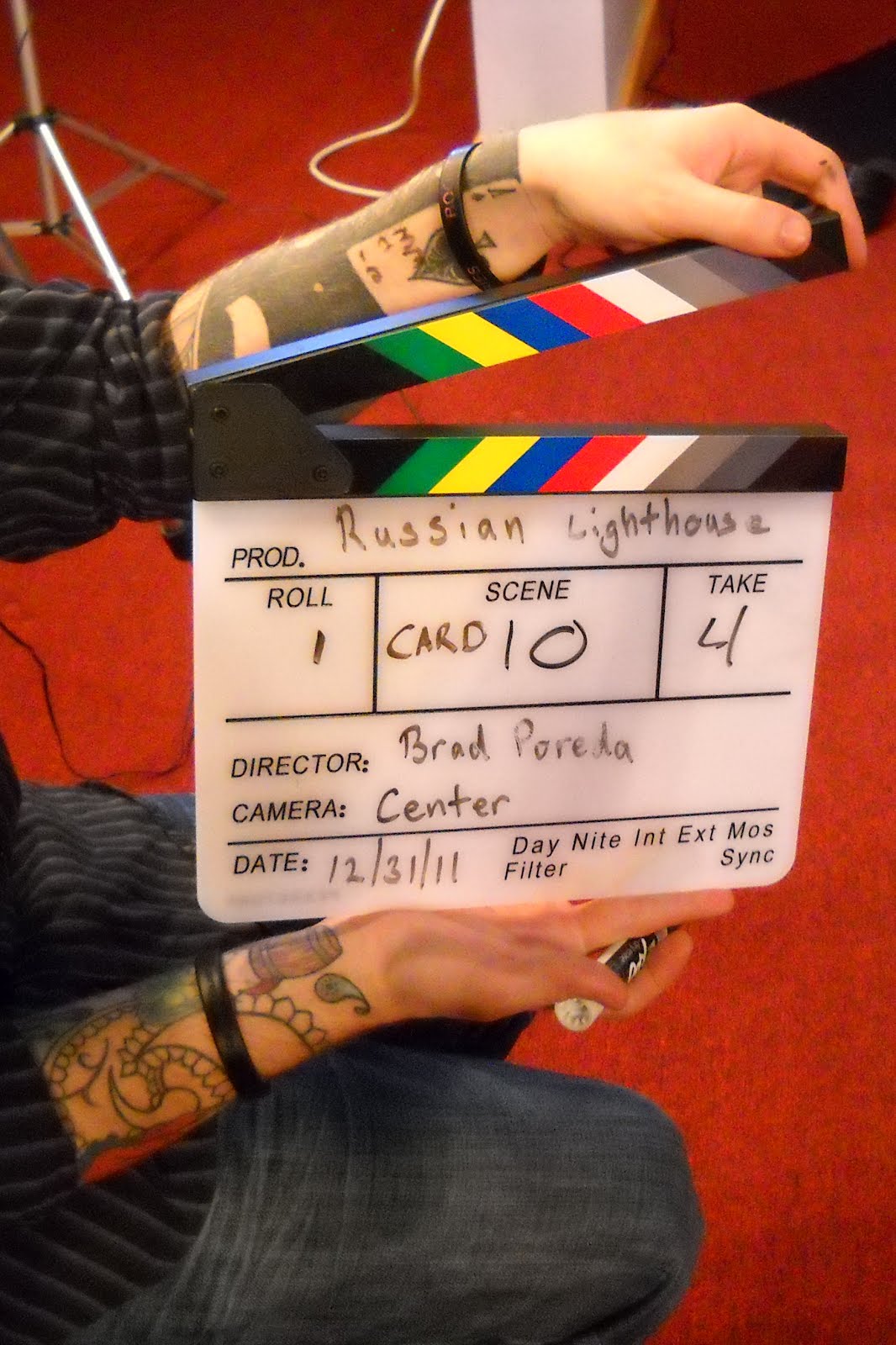
Six o’clock finds me in Jeff’s basement recording studio. A backdrop, large camera, lights, and several microphones alarm me, but the clapperboard labeled with my name makes things nauseatingly real. After several sound checks, practices of my introduction, and admonitions to slow down, Jeff says three of his friends will be helping Saturday. I should be delighted, but paradoxically, as this becomes more professional, I feel more stressed. As I leave, there is little solace at having survived the production meeting, as it is only prelude to what I truly dread. Jeff’s parting words, “Be here at 9:45 tomorrow morning,” ring like a threat.

Back at my in-laws’, I swallow nine Tums in a few hours; I haven’t taken nine the rest of my life. The next morning, I rise early since I’m not sleeping, and my nerves won’t tolerate a last minute rush anyway. I curl my hair, using a generous amount of hairspray from a travel bottle. I haven’t been anywhere since Russia last August, and I’ve forgotten how good it smells. A few minutes later, my hair looks oddly limp and lacks any hairsprayed crispiness, so I spray on more. When I smell the fragrance again, my confidence crumbles as I recall having refilled the bottle with body spray for Russia. Too late, I know why my hair is flat. There is no time to curl again. I can only put on my makeup, and go.

I am leaving when my mother-in-law asks an innocuous question; I start breathing hard and can’t answer. Next, I have a prickly head, and tears are welling in my eyes. “I can’t cry! I’m not going to cry!” I implore myself, as there is no time to clean mascara streaks if tears fall. I threaten to faint while she tries to shepherd me outside into Oklahoma’s omnipresent wind. I am coherent enough to resist, as I intend to salvage the little remaining wave in my hair. Finally, she pushes me into the car, and I calm down in the seat. “Just remember it’s not a matter of life or death,” she encourages me as I depart.

“It’s not, for me,” I agree, hoping she realizes this is life and death for the orphans I’ve met.

Jeff’s friends Brad and Doug arrive shortly after I do. Armed with microphones and cameras of their own, they eventually disassemble most of what we’d checked last night. As they decide where each gadget belongs, I strive to block out thoughts that this is all for me, and that I must deliver to make this worth their efforts. They rearrange the backdrop, overturn a couch, swap chairs, argue about placement of four cameras offering different angles, and call for props. As they work, they refer to me as “the talent.” I understand the lingo, and I am the authority here on my topic, but my inexperience makes the phrase feel hideously satirical.

Doug has a golden voice, and a new NPR show, Wind and Rhythm, to go along. He offers patient pointers on how to modulate my voice for best effect, but my weary, cortisol-addled mind renders me a slow study. I incorporate the hints I can, though most would take me years of practice to perform naturally. I have a large-print outline on a music stand just below the camera’s lens, acting as a primitive teleprompter. As I practice, Doug dislikes my reliance on the outline, so I end up taping short notecards to the stand, and they’re usually sufficient to jog my memory. He reminds me repeatedly that I’m only speaking to one person. I try to speak to the camera, but find it nearly impossible to project emotion to its black hole. Finally, he stands behind it at my eye level, and responds with exaggerated facial expressions to my words.

At 1 p.m., we’re ready to start filming. I am to be looking down when the camera rolls, then look up pensively before beginning. None of it comes naturally, except the mistakes; some elements need five or six takes before I get them right. It isn’t that I don’t know my material; in one sense, I have delivered this speech literally one thousand times, with the call notes to prove it. It’s just the medium is so foreign, and I’m so self-conscious, that the thought of having kids’ lives resting on my performance seems wickedly farcical. Tim, Jeff’s intern, sports enough piercings to look tribal, and an impressive array of tattoos darkens his arms, but he announces each take and scene with a fatherly patience and gentle clap of the clapperboard.

Rare parts of the presentation go almost well, and midway through, I accomplish a few segments where we don’t have to stop at all. But usually, even when I do a section multiple times, we have to settle for the best of several takes as “good enough.” Mercifully, just short of an hour, we’re done filming.

For the next several hours, Jeff and Brad download video from all four cameras. When Brad goes home to care for his dogs, Jeff and I start adding photographs. Timing them properly is maddening, and I wonder if any viewers will appreciate the photos enough to recompense our work. When Brad returns and we start editing, I learn the only thing worse than watching myself on video is watching myself make mistakes on video, while others focus on the miscues to decide which of the takes are least marred. But Jeff and Brad are unfailingly kind, and I never hear them laugh, except when I mess up my ending thank you by proclaiming, “Thank YOU for helping the Russians!”

Our progress is sloth-like, though. It’s New Year’s Eve, my favorite holiday, and I traditionally host a party. It grieves me to miss this; worse, I’m in the Central Time Zone, so I’ll have to delay my first Coca-Cola in a year for an additional hour (The Real Thing, 1/29/11). I’ve been in a 365-day countdown to toast my husband with a Coke-filled goblet at the stroke of midnight.

My mother-in-law knows I am disappointed, so she thoughtfully plans a little shindig for me. But as editing drags on, it’s clear I won’t even make that. I welcome 2012, not with the Times Square ball drop, but by watching the time change on my computer screen. Jeff has a refrigerator outside the studio stocked with Coke, but I can’t bring myself to imbibe without my husband. The moment I’ve ached for is here, and I’m in a basement control room. I almost start crying, but compose myself since Jeff and Brad are giving up their New Year’s Eve, too, and Lighthouse is not even their mission. I fret that by the time I leave, drunks will be out, and I’ll never get to see my family, drink my Coca-Cola, or help my orphans. About 1 a.m., Jeff’s wife delivers pizza, which cheers me as I hear myself intone about the orphan prostitutes of Russia for the umpteenth time.

For the end of the video, I’ve envisioned a quick photo progression of kids our work has helped, accompanied by the sound of cards shuffling. But for the thousands of sound effects on the software, cards aren’t one of them, so Jeff tries valiantly to create it himself. Brad hears the result and frowns. “You can’t use that! It sounds like farting!” he chides, suggesting a xylophone instead. Jeff searches online, and eventually finds an ascending chromatic scale. It’s perfect.

At 4 a.m., the parts needing my input are completed. Brad has fussy touches to finish, and thinks it will go faster if he is alone. I lay down on a couch in the recording studio, bemoaning the hour, yet solacing myself that the drunks will be home before I leave. I never really sleep; I just listen to my spiel ad infinitum as he works.

At 6:30 a.m., dear Brad is done. As he gives me a hug before leaving, I could almost cry that he gave up so much time to help our orphans, when he doesn’t know them, or me, or the Lighthouse Project. I thank him profusely; he’ll never know how much I’ve appreciated his help and expertise. While I didn’t give him much to work with, he has done a technically masterful job.

Jeff still has to copy the discs. When the first is done, he asks me to watch it. How many things I wish I would have worded differently, or could have written rather than spoken! I am not satisfied with my performance, but thankfully, it isn’t terrible with the most egregious errors edited out. After the second copy is made, I finally stumble to the car. The clock on the dash says 8:00 a.m.; we have worked on a 19-minute production for just over 22 hours straight.

I’m in a fog, but I drive slowly and meet only churchgoers on the road. Arriving at my in-laws’ house, my father-in-law comes out to greet me. I see him, and start to sob hysterically. I have been waiting all night to break down; the pressure of orphans needing me succeed at something so stressful is too much to resist longer.

Three hours later, smeared mascara washed from my face, I board the plane in Tulsa to return home. I can scarcely believe this video ever got made, especially under such crazy circumstances. Furthermore, the quality is far superior to anything I dared plan when Hope first asked me to do it. My heart might explode waiting for her return, so anxious am I to let her know not only did we work on the video as promised, we also finished it.
Arriving home Sunday night, I’m too spent to do anything besides collapse into bed. The next day, January 2, I cook my favorite dinner. With my family gathered round the table, I pop the top on my first Coke in a year and a day. I close my eyes and relish the fizzy assault on my nose. I could attack the Coke, but I delight instead in my deliberate control, knowing I am crossing my Rubicon. When I’m ready, I take one sip, and then another. It is thick, cloyingly sweet, and artificial. I don’t like it, not at all.

I pour a glass of cold water and drink deeply.

                         Somehow, I’ve survived.

See the video here.


Tuesday, January 17, 2012

Angels Will Watch Over You


Arrival in Moscow has heretofore meant navigating Sheremetyevo Airport’s dingy, tired, and cramped international terminal, but this trip our plane halts outside a building I’ve never been in. It is immaculate, modern, innovative, and expansive. If signs weren’t in Cyrillic, or if the flight attendant hadn’t welcomed us to Russia, I’d think I’d deplaned at a new airport in the United States.

The next day, I return to the airport to pick up my families. Ten are traveling, by far a record. They come on two flights, about an hour apart, so I chat with the first group as we await the second. Kate, a young girl whose parents adopted through our director Hope years ago, has read much of my blog. She reminds me of details I’ve revealed about myself in posts past, and wonders if I find it creepy she knows so much about me.

At the hotel, everyone unloads their bags. After their all-night flight, they good-naturedly vote to sightsee. Travel is my favorite hobby, and they delight me with their gameness to see a place that, despite its grittiness, has become my third-favorite city, after Grand Rapids and Venice.

The metro is the most sensible mode of transportation for us in Moscow. Before the trip I work hard to apprise the hosts of what to expect, but the metro deftly defies description. While I loathe pushiness, I warn families that boarding the metro is no time to be selfless. Still, I know that, early on, some chivalrous soul will step aside to let everyone else board ahead of them. It would be a nightmare to reconnect were we to be separated, even though we distribute Russian phones to all travelers, to be safe.

Sure enough, our first foray onto the metro, a few hold back to permit the rest of the group to meander in. When the alarm sounds to warn the door is closing, I physically stuff the person in front of me onto the train, and not a moment too soon, as the doors slam shut behind me. Beside me, an elderly lady also makes it. She smiles at us, very rare for Russians, as they believe to smile at strangers is to announce the smiler is crazy. She speaks to me in Russian, as I smile and nod. When she continues, I answer “Da!” though I haven’t any idea what she is saying. If the country is enjoying a nascent movement toward friendliness, I’d hate to squelch it. As she persists, I counter with da’s at each pause, until she finally realizes I’m not Russian. While speaking English is becoming more prevalent among the younger generation, the older the person or more menial their job, the less likely they are to know English. So the lady flabbergasts me when she abandons Russian and switches to first-rate English. “Angels will watch over you!” she declares. She asks a few questions, which I answer until the train grinds to another stop. The car is already standing-room only, and as more Muscovites shove their way aboard, the lady is swallowed by the crowd. “Angels will watch over you!” she calls as her parting benediction, slipping away.

We emerge from the metro’s tunnels just outside the Kremlin, which the group has chosen to see this trip. The world’s largest cannon, a 200-ton bell, and the official residence of the president of Russia lie within its red brick walls. While atheism was the state religion for over seventy years, this seat of Russian government also harbors five fifteenth-century cathedrals. A Russian Orthodox lady traveling with us to meet sisters finds the churches especially meaningful; watching her appreciate them blesses me, too.

After the Kremlin, we walk next door to Red Square. Two babushkas pose outside the Kremlin bell tower as a man takes their photo with a digital camera. When he shows them the result, they are so overcome with laughter they cry. I yearn to know if this is their first visit here, or their first digital photo, or if they’re just overwhelmed in this glorious place now that their land is free. It is the sweetest thing I’ve seen in Russia, and Kate snaps a few photos for the blog. How I wish I could see them laugh, to know their moment of joy is savored by others a world away!

Tomorrow morning our arms will open to the children now on their way to us. Today, though, it was our turn to be embraced, by this giant of a country. New friends from America are here, and I’ve been privileged to share with them just a few places I love in Moscow: this day embodies all that’s best about travel. Along the way, Russians we don’t know, and will likely not meet again, have shown their goodwill, and opened their hearts and the heart of their country to us.

Angels are watching over us.