Host dad Simon is very hip with his hair spiked; Igor is smitten with the look. Walking up to him, Igor utters an inflected “Um,” points to Simon’s head, and runs his fingers through his own hair. Simon helps Igor and two other boys coif their hair like his. Igor, especially, is proud, and I don’t see him again without spikes. At the end of the week, he asks Simon to give him the gel.
 After breakfast, Irina sequesters the kids in their room while we ready our gifts. When they return, we question them about their lives. Igor enjoys singing, so I ask for a song. For once, he acts bashful. “We shall support,” Ekaterina encourages him. It’s sufficient inducement, and he obliges with a haunting melody about a chained eagle. Zulya tells us Lora, her aunt, nicknamed her “Pelmini,” after Russian ravioli. Alexandra likes to sing, but cannot be cajoled to do it now. My first glimpse of her personality comes when she glows, speaking about her friends. Alexander, safe in the certainty of already having been chosen by an adoptive family, divulges a few tidbits about himself, then adds in a small voice, “What else do you want to know?”
Several of the kids are in foster care, just for the summer, to give them an experience with a family. I wonder, but don’t ask, why these families don’t care the rest of the year. All the kids have farm jobs with the families, which none appear to object. Igor smiles, noting that when he finishes helping with the hay, there’s always cake on the table awaiting him. Ekaterina and Zulya dream of going to America. Asked what he wants to be in the future, Igor deadpans, “A star.” With his personality, it’s hardly far-fetched.
 When the kids query us, one horrifies me with, “If you had to take one of us to an island, which one would you take?” There are more kids than adults, and I warn the families not to answer. We’re asked about our houses, if we live in apartments, and if we have our “own children.” Zulya wonders if we’re waiting for great-grandchildren. When they ask about money, Trevor offers to show them a US dollar bill. It is the most excited the kids get the entire trip, and the hosts decide to give each child one to keep.
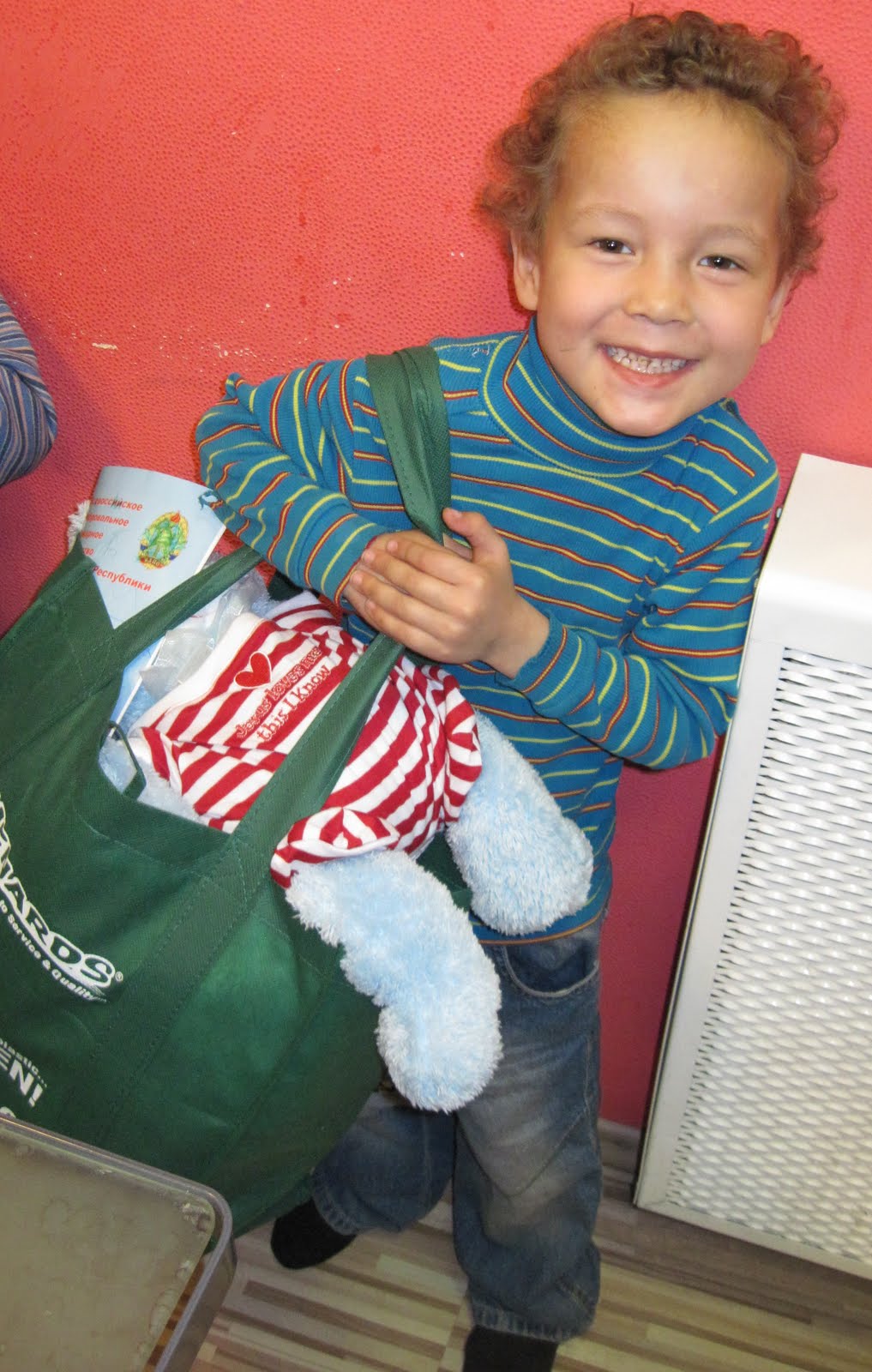
After more than an hour of questions, the kids get their gifts. Much energy is spent sorting through their bags, comparing contents, and displaying the loot. We derive as much pleasure watching their joy as they get in receiving. One Virginia family I’ve spoken with for over two years sends a wrapped gift for each unhosted child, along with a card. The kids know they should open the card before the accompanying gift. Each asks Irina to read theirs to them, and they listen with rapt attention.

By the time we leave for lunch at MuMu, the 10% chance of rain Moscow meteorologists predicted has become a 100% chance. There aren’t enough ponchos to go around, so Igor and Vladimir share. After eating, we find the Ferris wheel commemorating Moscow’s 850th anniversary operating, even in the inclement weather. It costs about $8 for one revolution, but we enjoy a view of Moscow its birds would envy. Unassuming Alexandra is so giddy to board that she pushes Joyce, her host, through the turnstile. She wears a nonstop grin the entire ride that Joyce claims was worth the cost of all our tickets. With the child so hesitant to assert herself, I am thrilled we did something she enjoyed.
After the ride, we visit an old park next door built to exhibit the agriculture and industry of the Soviet Union. Now its eighty-odd pavilions mainly house small shops, but it’s still a weekend destination for Muscovites. At the Friendship of the Peoples fountain, sixteen gilded maidens, each dressed in a costume of a different former Soviet republic, circle sheaves of wheat. The fountain, on a list of the ten most beautiful in the world, aimed to honor the bond of friendship between the republics, united under the glories of communism. While the fountain isn’t running today due to rain, and the union it celebrates has collapsed, we still find it worthy of its top-ten billing.
After the ride, we visit an old park next door built to exhibit the agriculture and industry of the Soviet Union. Now its eighty-odd pavilions mainly house small shops, but it’s still a weekend destination for Muscovites. At the Friendship of the Peoples fountain, sixteen gilded maidens, each dressed in a costume of a different former Soviet republic, circle sheaves of wheat. The fountain, on a list of the ten most beautiful in the world, aimed to honor the bond of friendship between the republics, united under the glories of communism. While the fountain isn’t running today due to rain, and the union it celebrates has collapsed, we still find it worthy of its top-ten billing.
 Some of the kids have a few rubles for the trip. I don’t know where they got them, but assume they’re from the summer foster families. Zulya is itching to spend hers, and after the Ferris wheel we pass carnival games. A man is chanting into a megaphone, though we’re the only ones here. Zulya pulls me aside and insists on playing his game. I think it’s a waste, but when she wins a Russian-speaking stuffed cow, her joy is boundless, and she shows it to everyone. The last day she is still clinging to it, and even I must admit the happiness she’s derived exceeds in value whatever she spent to win it.
We eat dinner at the hotel, then some of the kids ask to play in the rain at a playground. Every fiber of my being screams “Nyet!,” but when they ask me to take them, I hear myself agreeing. Igor marks the way with sidewalk chalk, so we won’t have trouble finding our way back. Both my compassion and my skimpy Russian restrain me from telling him it’s unnecessary, as I have a very good sense of direction. Two cats watch us out a screened window along the way; I love cats and instinctively call, “Here, Kitty, Kitty, Kitty!” several times, mesmerizing the kids. The next morning they tell Irina and insist I demonstrate my cat-calling prowess to her.
 When we’re done at the park, I retreat exhausted to my room. Exhaustion is reassuring, like a report card, that I poured everything into my mission today. It’s been a profitable gleaning of insights into the kids’ personalities, details I hope will help me help them. Sinking into sleep, I revel in how Sergei’s kind gesture in the metro enriched us all.
 I hope he is repaid a thousand-fold.
Tweet